Can you eat fruit on low-carb? Pick a fruit and see how much of your limit it uses
Can you eat fruit on low-carb? It depends on the fruit, the portion and how low your limit is. Pick a fruit, set a portion and choose a daily carb limit to see how much of it that portion uses up.
Berries and melon go a long way, while bananas, grapes and dried fruit use a limit fast. Figures come from USDA data and NHS portion sizes, and are estimates.
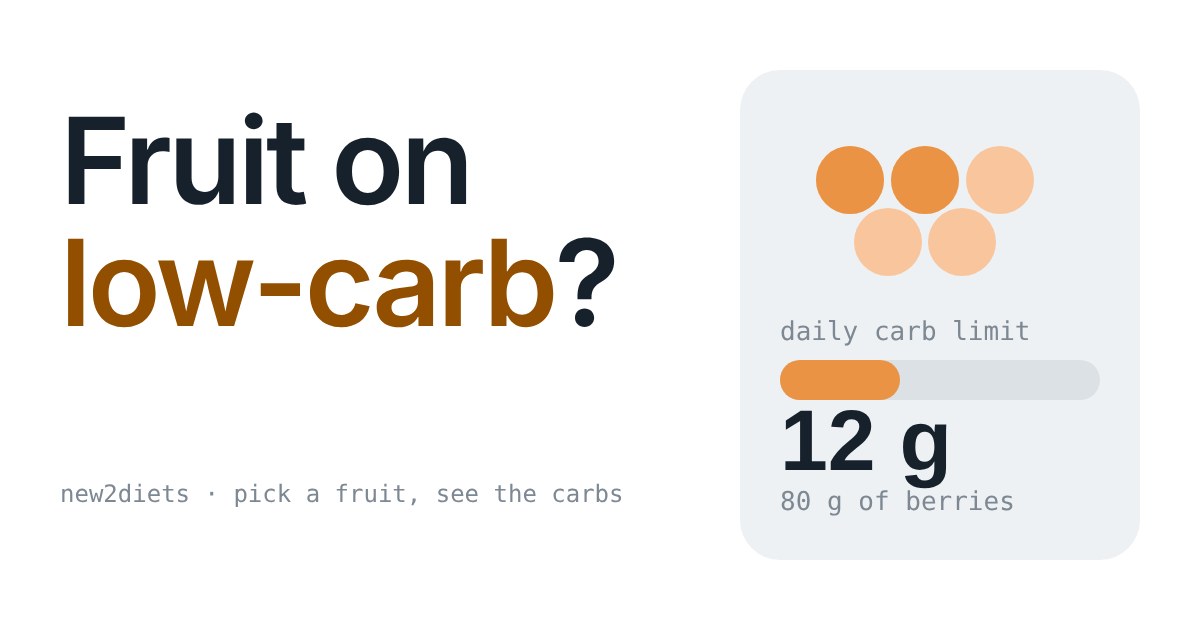
Fruit is the food people on low-carb most often wonder about. It is healthy, and it is also sweet, and sweet usually means carbohydrate. The honest answer is that it depends on which fruit, how much, and how low your carb limit is. Pick a fruit below, set a portion and a daily limit, and see where it lands.
Why fruit has carbs at all
Fruit gets its sweetness from natural sugars, mainly fructose, glucose and sucrose, and sugars are carbohydrates. Most fruit is mostly water, so a typical 80 g portion (the size the NHS uses for one of your five a day) holds somewhere between about 6 and 18 g of carbohydrate. That is small next to a 150 g portion of cooked rice, but it adds up fast on a tight limit.
Where the line falls
There is no single official definition of low-carb. Many health services call under about 130 g of carbohydrate a day "lower", while keto-style eating is usually much stricter, often 20–50 g a day. The same 80 g of blueberries is a rounding error on the first limit and a quarter of the second. That is why the tool lets you change the limit.
The lower your limit, the more the fruit you choose matters. Berries and melon go far. Bananas, grapes and dried fruit go very fast.
What the tool shows
Berries, especially strawberries, raspberries and blackberries, give you the most fruit for the least carbohydrate. Raspberries and blackberries also bring a lot of fibre. Melon, peach and citrus sit in the middle. Banana, grapes and pears are at the high end. Dried fruit is the extreme case: the water is gone, so 30 g of raisins (the NHS portion for dried fruit) has more carbohydrate than 300 g of strawberries.
Avocado is botanically a fruit and is very low in carbohydrate, most of it fibre. It is also high in fat and calories, so portions matter for a different reason.
Is it worth keeping fruit in?
The WHO recommends at least 400 g of fruit and vegetables a day for everyone over ten, and it counts fresh, and unsweetened frozen or canned fruit, as good choices. Fruit juice is different: even unsweetened juice contains free sugars, so it is best kept small. On a low-carb pattern, vegetables are usually the easiest way to reach that 400 g, with a portion of berries as the fruit. If you choose to cut fruit out entirely, that is a decision to make with a dietitian, because fruit also supplies vitamin C, potassium and fibre.
What to look for when you shop
- Whole, fresh or plain frozen fruit over juice, smoothies and dried fruit.
- Frozen berries are a cheap way to keep berries around all year, as long as nothing is added.
- Weigh a portion once or twice. Eyeballing a handful is often twice what you think.
- Check the label on tinned fruit: "in juice" or "in syrup" adds carbohydrate.
Before you change how you eat
This is general information, not medical advice. If you have a condition such as diabetes, are pregnant or breastfeeding, have or have had an eating disorder, or take medication (especially for diabetes or blood pressure), talk to a doctor or dietitian before cutting carbohydrate. Carbohydrate numbers here are estimates: fruit varies by variety, ripeness and size.
Sources
- USDA FoodData Central: carbohydrate and fibre per 100 g of raw fruit.
- NHS: 5 A Day portion sizes: 80 g fruit portion, 30 g dried fruit, limits on juice and smoothies.
- WHO: Healthy diet fact sheet: at least 400 g of fruit and vegetables a day, and juice and free sugars.
- FAO food composition table for fruit: a second table, showing values differ by a few grams between sources.