What does the first week of low-carb feel like? Slide through the days and see
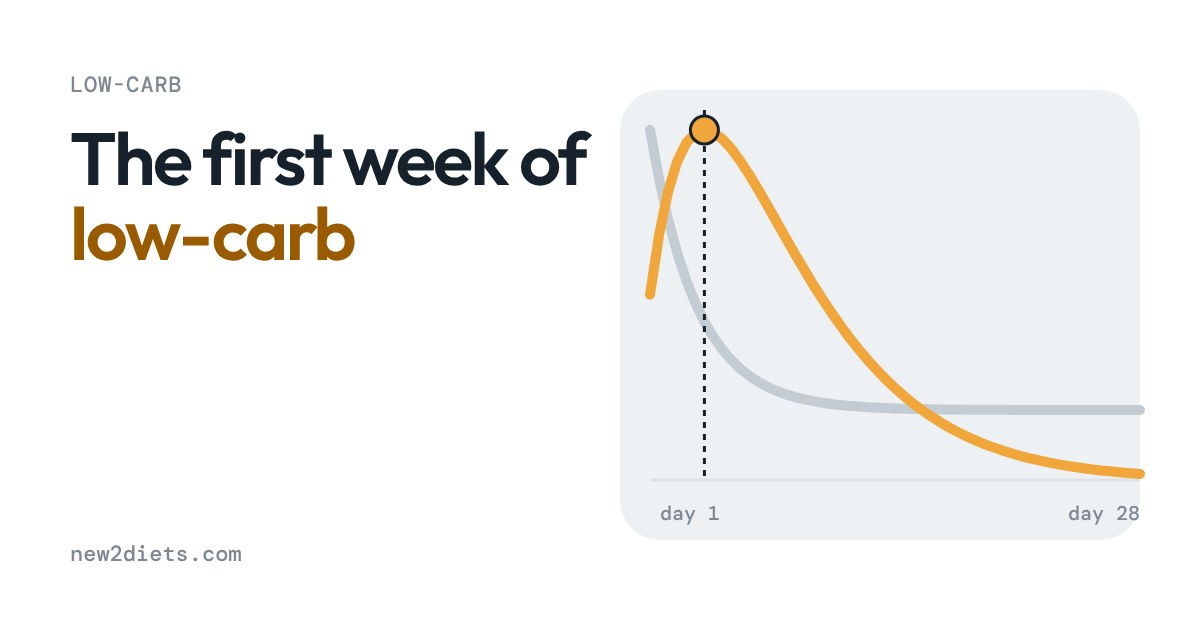
Cut carbs sharply and the first week can feel rough: headaches, tiredness, foggy thinking. Slide through the first 28 days to see what people report and when it usually eases.
We explain the likely reasons, how thin the evidence is, what may help, and who should talk to a doctor or dietitian before starting. This is not medical advice.
Is a rough first week normal?
Plenty of people who cut carbohydrate sharply say the first days feel odd: a headache, a foggy afternoon, tiredness that wasn't there before. Online it gets called "keto flu". It is not a medical diagnosis, and not everyone gets it, but the pattern is common enough in people's own accounts that it helps to know what to expect, and when to stop and ask for help.
Why it might happen
Nobody has pinned down one cause. The most common explanation is that your body is adjusting to a new main fuel. Glycogen is stored with water: a long-standing figure is at least 3 g of water for every gram, so using up the store releases water, which you pass as extra trips to the toilet. Losing fluid (and the salt that goes with it) may add to headaches, dizziness and tiredness. A big change in what you eat, including less fibre if you swap bread and fruit for meat and cheese, can unsettle your gut. These are plausible explanations, not proven ones.
What the evidence actually is
The best-known study of "keto flu" read posts from online forums, collecting accounts from 101 people on ketogenic diets. It reported headaches, poor concentration, fatigue, nausea, dizziness and stomach upsets, usually peaking in the first week and fading by about four weeks. That is useful, but it is self-reported, from people who chose to post, and the researchers did not confirm anyone's ketone levels. It shows a pattern, not how common it is.
For scale, a "low-carb" diet is usually defined as under 130 g of carbohydrate a day, and a very low-carb (ketogenic) one as roughly 20–50 g. The dietitians' body in the UK says low-carb diets work for weight loss but are no more effective than many other diets, and that the best diet is the one you can live with and that meets your nutritional needs. Where the evidence is mixed, as with long-term effects, treat any strong claim with caution.
What may help
- Don't cut everything at once. Reducing carbs step by step is a reasonable way to give your body time. Keep eating enough overall; this is not the time for a crash diet.
- Keep fibre up. Vegetables, pulses in your carb allowance, nuts and seeds help your gut. Many guidelines suggest about 30 g of fibre a day.
- Drink to thirst and eat regularly. Forum posters often mention extra salt and fluids. The evidence is anecdotal, so if you have high blood pressure or kidney problems, or take medication, ask before changing your salt.
- Go easy early on. Save the hardest workouts for when your energy returns.
When to ask for help
Low-carb eating is not for everyone. Speak to a doctor or dietitian first if you have a health condition, are pregnant or breastfeeding, have or have had an eating disorder, or take medication. Very low-carb (ketogenic) diets are not advised in pregnancy. If you have diabetes, medicines such as insulin or sulfonylureas may need to be reduced to avoid dangerously low blood sugar, and that must be done with your care team, not on your own.
Get medical advice if symptoms are severe, still there after a few weeks, or if you vomit repeatedly, cannot keep fluids down, faint, feel confused, or have chest pain or a racing heartbeat.
A rough first week is common in people's reports and usually passes, but "usually" is not "always". If it doesn't feel right, it is fine to stop.
Sources
- Bostock et al., "Consumer reports of 'Keto flu' associated with the ketogenic diet", Frontiers in Nutrition, 2020 (summary)
- British Dietetic Association, Low-carb diets food fact sheet
- Fernández-Elías et al., "Relationship between muscle water and glycogen recovery after prolonged exercise in the heat in humans", European Journal of Applied Physiology, 2015