Do you need more carbs when you train? Enter your weight and see where low-carb lands
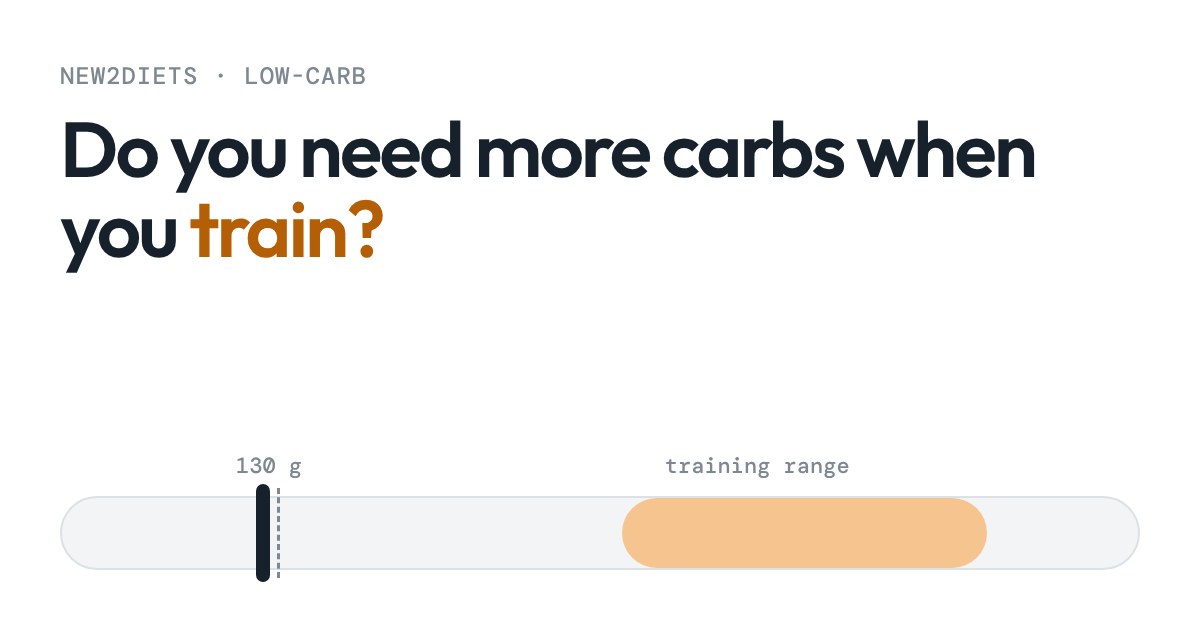
Do you need more carbs when you train? Sports nutrition guidance is written in grams of carbohydrate per kilogram of body weight, and even moderate training ranges sit well above the usual 130 g low-carb line.
Enter your weight, pick how much you train and slide your own daily carbs to see the gap, what the research says about low-carb for easy and hard sessions, and when to ask a dietitian. Estimates only, not medical advice.
Low-carb and exercise: do they fit?
Carbohydrate is the fuel your muscles reach for first, stored as glycogen (a store of sugar in muscle and liver). The harder and longer you train, the faster that store drains. So when you eat low-carb, a fair question is: does my workout week need more than my food plan gives me?
Sports nutrition guidance answers that in grams of carbohydrate per kilogram of body weight per day. Set your weight and your training below, then slide your own daily carbs to see where you land.
Where the numbers come from
The ranges in the tool come from a joint position of the American College of Sports Medicine, the Academy of Nutrition and Dietetics (then the American Dietetic Association) and Dietitians of Canada. They suggest roughly 3–5 g/kg a day for a moderate exercise programme of about an hour a day, 6–7 g/kg once training goes past an hour a day, and 7–10 g/kg for endurance training of one to three hours a day. A German sports-nutrition position (DGE, 2020) gives a wider 6–12 g/kg for athletes who train long or hard.
For a 70 kg person, the moderate band is 210–350 g a day. Compare that with the usual definition of low-carb: under about 130 g, which is only around 1.9 g/kg at 70 kg. For general health, EFSA gives a reference range of 45–60% of energy from carbohydrate, which is roughly 225–300 g on a 2,000 kcal day.
Even moderate training ranges sit above the low-carb line. That does not mean low-carb exercise is impossible, only that it asks for a trade-off.
What low-carb does to training
The research is mixed and depends on what you do:
- Walks, easy cycling, gentle sessions. The NSCA review says low-carb eating may suit some endurance and steady, lower-intensity work, but adapting can take two weeks to a few months, and performance can dip along the way.
- Hard, fast or heavy efforts. Sprints, intervals and heavy lifting rely on glycogen, which is used up faster than fat or ketones can supply energy. A strength-and-conditioning review (NSCA) calls keto impractical for high-intensity sport.
- Long, hard endurance. The German position says top endurance performance cannot do without carbohydrate, and whether “training low” helps competition results is unproven.
The guidance above is written for people training for performance. If you move to feel well and stay healthy, you may not need those figures at all. WHO's advice for adults is at least 150 minutes of moderate activity a week, plus muscle-strengthening on two or more days, and it does not set a carbohydrate target.
What to do with this
If you train hard and eat low-carb and feel flat, dizzy or unusually tired, that is a signal to look at your carbs and your total food, not to push through. Eating more is a normal answer, not a failure. A registered or sports dietitian can build a plan around your sessions.
This is general information, not medical advice. If you have a condition, are pregnant or breastfeeding, have or had an eating disorder, or take medication (especially for diabetes or blood pressure), talk to a doctor or dietitian before changing how you eat or train.
Sources
- US Public Health Service bulletin summarising the ACSM / Dietitians of Canada / American Dietetic Association position on nutrition and athletic performance (2009)
- Carbohydrates in sports nutrition: position of the German Nutrition Society (DGE), 2020
- NSCA: considerations for low-carbohydrate diets
- EFSA: dietary reference values for nutrient intakes
- WHO: recommended amount of physical activity