Where do raw chicken germs travel in your kitchen? Tap your next move and see
You have just cut raw chicken, and the salad still needs chopping. Cooking kills the germs on the chicken, but anything raw-chicken touches before it is cooked, or that you eat without cooking, can pick them up.
Play out the next five minutes in a simple kitchen model: tap what you would do next and watch where the germs travel, from hands to tap to towel to salad. Then see what WHO, EFSA and the UK Food Standards Agency advise: separate boards, warm soapy water, bottom-shelf storage and cooking through. General food-safety information, not medical advice.
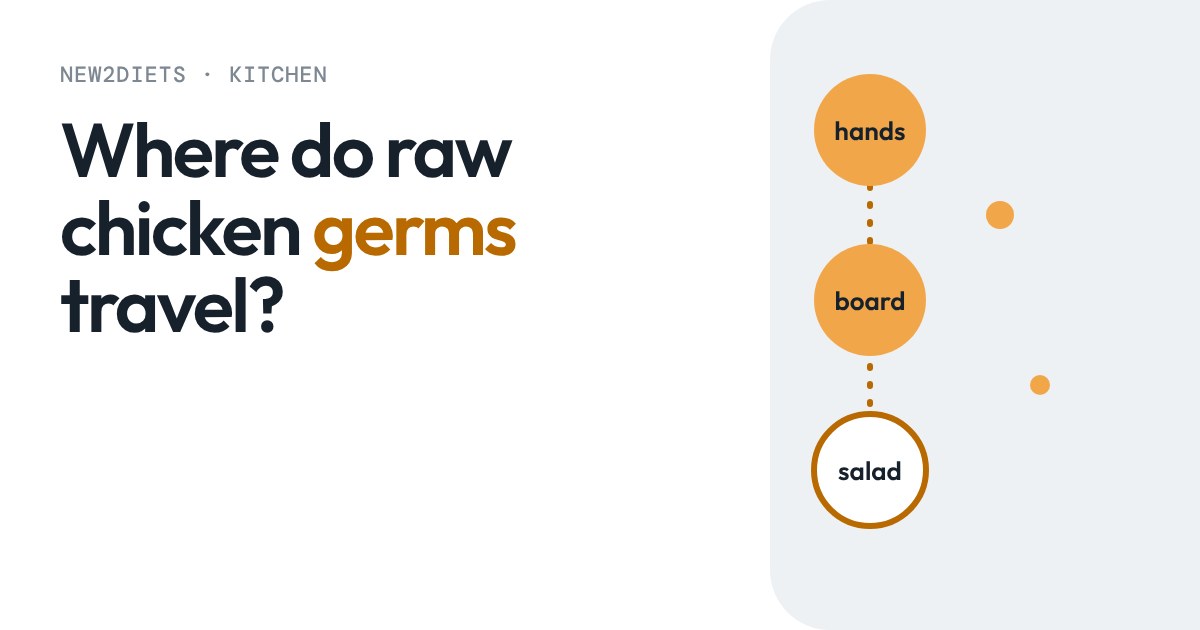
You have just cut raw chicken on a board. Dinner is not done, and the salad still needs chopping. The germs on raw poultry are killed by cooking, but anything that touches them before it is cooked, or that you eat without cooking, can pick them up. This is called cross-contamination, and it is one of the most common ways a kitchen makes someone ill.
Play out the next five minutes
Everything marked below starts with raw-chicken germs on your hands, board, knife and plate. Tap what you would do next and watch where the germs go. There is no score to win; the point is to see the path.
What the guidance says to do
Public health bodies agree on the basics, and none of it needs special kit.
- Keep raw and ready-to-eat apart. WHO and EFSA both say to use separate knives and cutting boards for raw food, and to store raw and cooked food separately in the fridge.
- Wash boards, utensils and hands in warm soapy water after they touch raw or thawing meat, according to the UK Food Standards Agency (FSA). In an FSA study that watched real households, only about one in five meals involving meat or fish ended with the board washed with detergent; roughly as many used water alone.
- Raw meat goes on the bottom shelf, in its packaging or a sealed container, so it cannot drip onto other food. Keep the fridge between 0 and 5 °C.
- Cook it through. The FSA gives the middle of the food reaching 70 °C for 2 minutes (or an equivalent such as 75 °C for 30 seconds). Cut into the thickest part of chicken: no pink meat and clear juices. Clean the probe after every use.
- Don't leave cooked food out. Cool it and get it into the fridge or freezer within one to two hours.
Cooking kills the germs on the chicken. Washing and keeping things apart stops them reaching the food you won't cook.
A simple order for the kitchen
- Prepare ready-to-eat food (salad, bread, fruit) first, on its own board.
- Handle raw meat last, on a separate board.
- Wash hands with warm soap and water straight after, before touching taps, handles or the towel.
- Wash the board and knife in warm soapy water, with a scrub.
- Serve cooked food on clean plates, never ones that held it raw.
A note on who should be extra careful
This is general food-safety information, not medical advice. Food poisoning is usually short-lived, but it can be serious for babies and young children, older people, anyone who is pregnant and anyone with a weakened immune system. If you are in one of those groups, or you are ill after eating, talk to a doctor or pharmacist.