Does your metabolism slow down as you get older? Slide your age and see
Many people blame a slowing metabolism for weight gain in adult life. A large 2021 study that measured the energy of 6,421 people from newborns to 95-year-olds found something different: for a body of the same size and make-up, energy use is flat from about 20 to 60.
Slide the age and see where it peaks, where it stays level, and where it begins to ease, plus what really changes through the years.
Does your metabolism really slow down as you get older?
Almost everyone has heard it: "my metabolism slowed down in my thirties". It is one of the most common explanations for gaining weight in adult life. A large study published in 2021 measured how much energy people really burn at every age, and the answer was a surprise. For most of adult life, the rate does not change much at all.
Your metabolism here means the total energy your body uses in a day, in calories (kcal). Slide the age below to see how that changes across a lifetime, for a body of the same size and make-up.
What the study found
The study, led by Herman Pontzer and published in Science in 2021, pooled measurements from 6,421 people in 29 countries, from newborns to 95-year-olds. Energy use was measured with doubly labelled water, a method that tracks a harmless tagged form of water through the body over one to two weeks. It is far more accurate than asking people what they eat. The researchers then adjusted for body size, muscle and fat, so that a larger person was not mistaken for a "faster" one. Four phases came out:
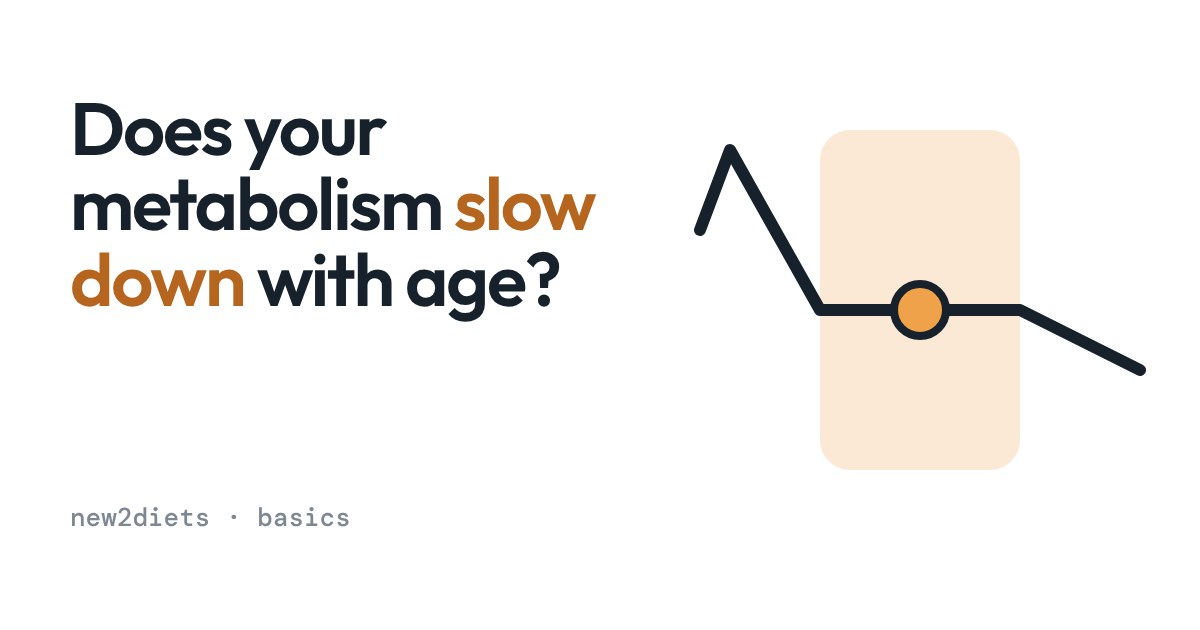
- Infancy: energy use per body size rises quickly and peaks around age 1, about 50% above adult levels.
- Childhood to about 20: it falls slowly, about 2.8% a year, until it reaches the adult level. There was no extra boost at puberty.
- About 20 to 60: stable, including during pregnancy.
- After about 60: it declines, by roughly 0.7% a year.
The data are averages, and individuals differ. Basal metabolism measured at rest followed a similar pattern, but its turning points were less precise, so treat the exact ages as approximate.
So why do people gain weight in adult life?
The study does not say weight never changes. It says a slowing metabolism is not the main reason in your twenties, thirties, forties and fifties. Other things plausibly do more work, and some of them are in your hands:
- Muscle. People tend to lose muscle through adult life if they do not use it. Muscle takes a little energy to maintain, so this matters more for your capacity to move than for your metabolism. Your body size and make-up already feed into any calorie estimate.
- Movement. Desk jobs, commuting and caring for others can quietly cut daily activity, which is the part of your energy use you can change.
- Food and drink. Larger portions, more snacks and drinks, and more eating out add up slowly. A surplus of just 50 kcal a day is the size of a biscuit.
- Sleep and stress. Both can shift appetite and routine.
Hormone changes such as the menopause can change body composition and sleep. The 2021 study did not single them out, so we do not claim an effect on metabolism either way. If you feel your body has changed, a doctor can look at the whole picture.
For about forty years of adult life, your metabolism stays level. What changes is how you live, not how fast you burn.
What to do with this
Keep using estimates that include your age, weight and height as a starting range, and remember every estimate can be out by 10% or more. Adjust by how you feel and how your weight trend behaves over weeks, not by a single number. Aim to stay active and to include some strength work as the years go on, in whatever form suits you. Over 60, appetite and muscle matter more, so eating enough protein and enough food overall is the priority, not eating less.
This guide is general information, not medical advice. If you have a medical condition, are pregnant or breastfeeding, have or have had an eating disorder, or take medication (especially for diabetes or blood pressure), talk to a doctor or dietitian before you change how you eat. If you are losing weight without trying, or are worried about your appetite, see a doctor.
Sources
- Pontzer H, Yamada Y, Sagayama H, et al. Daily energy expenditure through the human life course. Science 2021;373:808-812. The main data for the ages and rates above.
- Duke University. Metabolism changes with age, just not when you might think. Plain-language summary of the study.