How much fibre is 30 g? Build a day of eating and see where you land
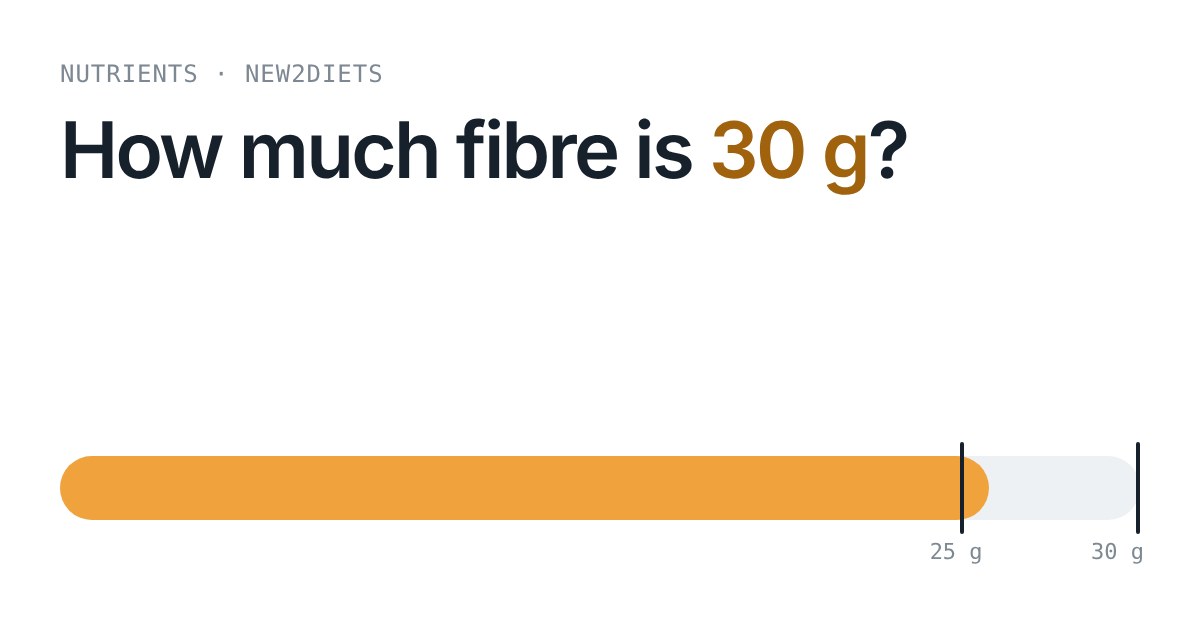
Health bodies suggest 25 to 30 grams of fibre a day, yet most adults in the UK and much of Europe eat noticeably less. That sounds like a lot until you see what a gram of fibre looks like on a plate.
Build a day of eating with a simple counter, see where you land, and find the few foods that move the total most. It is a guide, not medical advice.
Why 30 grams shows up everywhere
Fibre is the part of plant foods your body can't fully digest. It adds bulk, feeds the bacteria in your gut and slows how quickly the food around it is absorbed. Public health bodies agree on the rough target: 25 g a day from the WHO and EFSA (the European Food Safety Authority), and 30 g a day for adults from the UK's SACN (Scientific Advisory Committee on Nutrition). Most adults in the UK and many other European countries fall short, with an average in the UK of around 20 g.
The two numbers are not in conflict. EFSA set 25 g as the amount that supports regular bowel movements, while noting that larger intakes may bring extra benefits. SACN looked at heart disease, type 2 diabetes and bowel cancer and chose 30 g. The evidence is mostly from large observational studies, so it shows a link rather than proof, but a major 2019 review in The Lancet found the lowest risks among people eating the most fibre.
Aim for 25–30 g. Closer to either number beats the average, and you don't need to hit it exactly every day.
Build a day and see where you land
Tap + to add a portion of each food. Amounts are rounded estimates for a normal serving and real foods vary by brand and ripeness, so treat the total as a guide of about plus or minus 20%.
The easy wins
The foods that move the total most are the same few families: pulses (lentils, beans, chickpeas), whole grains (oats, wholemeal bread, wholewheat pasta), fruit and vegetables with their skins, and nuts and seeds. Swapping white for wholegrain versions is often the single cheapest change, because the fibre sits in the outer layers of the grain that refining removes.
Tinned and frozen count too. Tinned beans, frozen peas and frozen berries have fibre much like the fresh versions, and they keep, so a few in the cupboard make a high-fibre meal easy on a tired evening.
Go up slowly
If you currently eat well under 20 g, jumping to 30 g overnight can cause bloating, gas and cramps. Add one extra portion every few days, and drink water through the day, since fibre absorbs fluid. Gut bacteria adapt over a couple of weeks, and the discomfort usually settles.
Not medical advice. If you have a bowel condition such as IBS, Crohn's disease, ulcerative colitis or coeliac disease, a history of bowel obstruction, difficulty swallowing, are pregnant or breastfeeding, have or had an eating disorder, or take medication (especially for diabetes), talk to a doctor or dietitian before changing how you eat. Children need less: SACN suggests about 15 g at ages 2–4, 20 g at 5–10, 25 g at 11–15 and 30 g from 16.
Where this comes from
- SACN, Carbohydrates and Health (2015): 30 g a day for adults.
- EFSA, dietary reference values for carbohydrates and fibre (2010): 25 g a day.
- WHO, Healthy diet fact sheet: at least 25 g a day from whole foods.
- British Dietetic Association, Fibre and the NHS guide to getting more fibre: food sources and gradual increase.
- Reynolds et al., The Lancet (2019): carbohydrate quality and health, observational evidence.