Where does saturated fat hide? Tap your foods and see how your day adds up
Saturated fat is easy to overshoot because it hides in pastry, cheese, sausages and chocolate, not only in butter. Tap the foods you ate and see how your day compares with the WHO limit of 10% of energy.
Learn why the limit exists, what the research says about swapping fats, and which easy swaps move the average most. General information, not medical advice; ask a doctor or dietitian if you have a heart condition or high cholesterol.
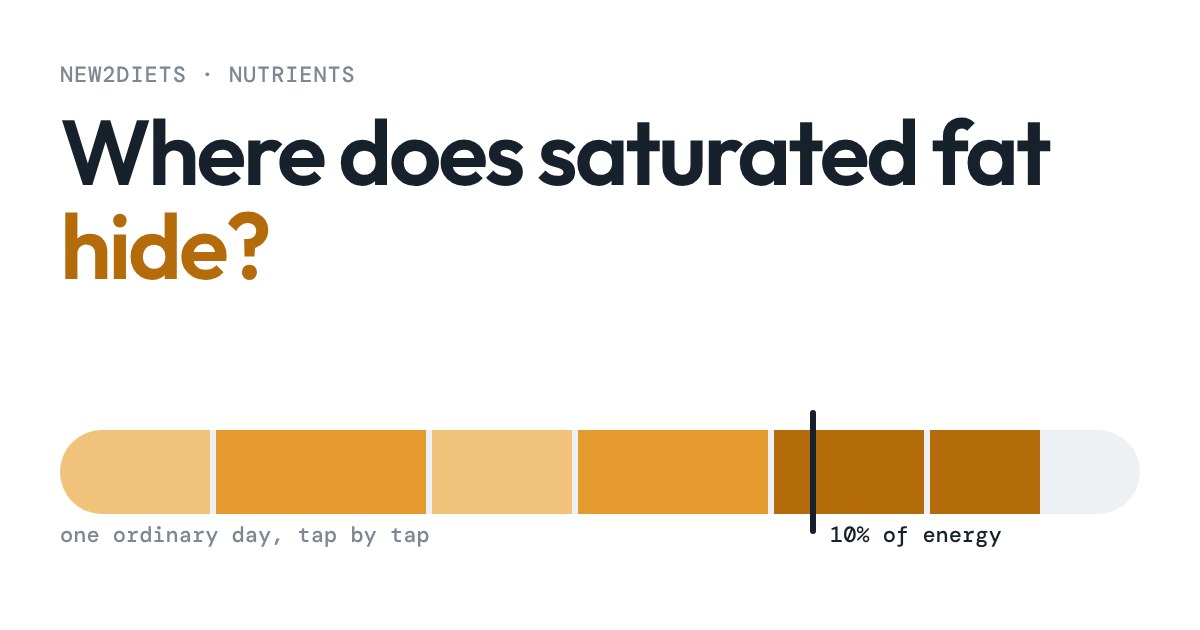
Saturated fat is the fat that is usually solid at room temperature: butter, the white edge on a lamb chop, the layer in a block of cheese. Public health bodies agree on one simple limit for it, and most people have no idea how fast it adds up. Let's find out where it hides in a normal day.
What the limit actually is
The World Health Organization says saturated fat should stay under 10% of your daily energy, and that most of your fat should come from unsaturated sources instead. Fat has about 9 kcal per gram, so at 2,000 kcal a day that is roughly 22 g. UK guidance rounds this to about 20 g a day for women and 30 g for men, based on average needs. Your own number depends on how much you eat, which is why the tool below lets you change it.
Why the limit exists
Eating a lot of saturated fat raises LDL ("bad") cholesterol in most people, and high LDL is a risk factor for heart and blood-vessel disease. A Cochrane review of trials lasting at least two years found that cutting saturated fat lowered combined heart and stroke events by about 17%. Two details matter. The benefit came when people swapped it for polyunsaturated fat or starchy foods, not when they just removed it. And the review found little effect on the risk of dying from any cause, so this is about heart health, not a magic switch.
The research is mixed on individual foods. Some dairy foods such as yoghurt and cheese seem to affect health less than their saturated fat would suggest, while processed meat and pastry do worse. Treat the limit as an overall guide for your pattern of eating, not a ban on any one food.
Where it hides
Try the tool again with a normal day: a croissant for breakfast, cheese in a sandwich, a burger or a slice of pizza at dinner, a bar of chocolate. It is easy to reach the limit with foods that do not taste "fatty". Pastry, biscuits, cakes, sausages, cream, butter and coconut oil are the usual big hitters. Fish, eggs, nuts, olive oil and avocado have fat too, but most of it is unsaturated. Beans and lentils have almost none.
Think swap, not subtract: change the butter for olive oil, the sausage for beans, and the fat you cut is replaced by a better one.
What to try
You do not need to count grams every day. A few swaps move the average more than careful counting does:
- Cook with olive or rapeseed oil instead of butter, lard or coconut oil.
- Choose lean cuts and trim the visible fat; have fish, beans or lentils a few times a week.
- Read the label: "saturates" is the line under fat. Per 100 g, more than 5 g is high and 1.5 g or less is low (UK traffic-light guide).
- Keep cakes, pastry and chocolate as treats rather than daily habits.
Total fat still matters for energy, but WHO suggests keeping it at or below 30% of calories, mostly from unsaturated fats. Trans fats should stay under 1%.
Who should ask first
This guide is general information, not medical advice. If you have heart disease, high cholesterol, diabetes, a family history of early heart problems, are pregnant or breastfeeding, have or had an eating disorder, or take medication, talk to your doctor or a registered dietitian before changing how you eat. Some people are told to keep saturated fat well below the general limit. Children under two should not follow adult limits. The figures above are rounded estimates, and real portions and brands differ by 10% or more.