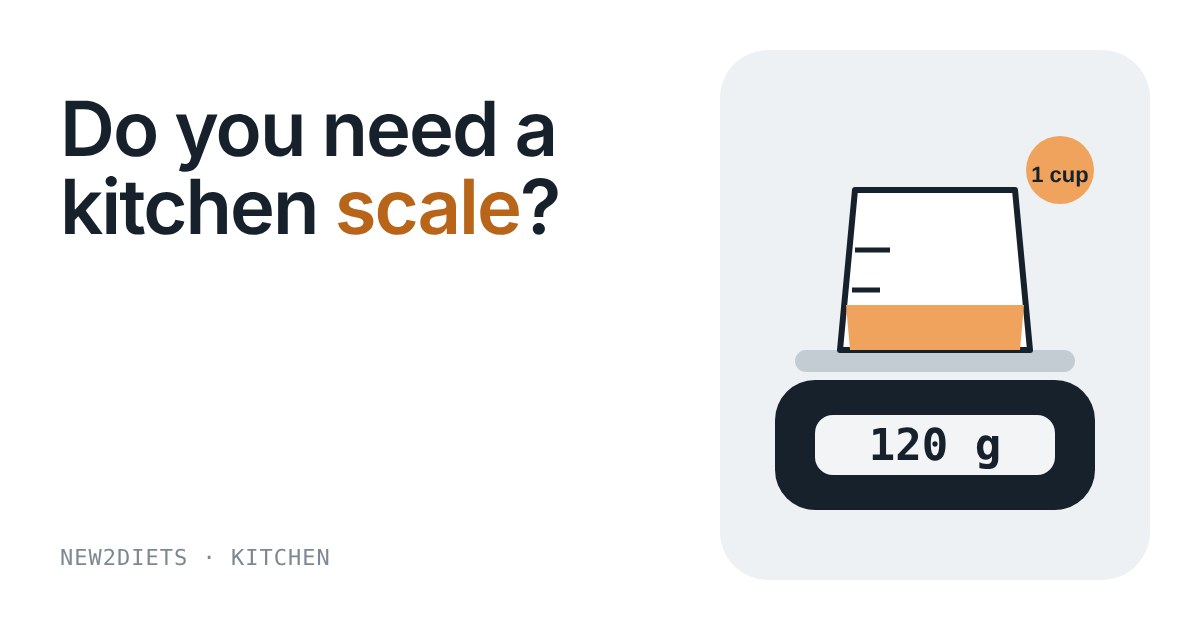
Recipes and food trackers love measuring cups and spoons. They feel quick, but they measure space, not food. A cup of olive oil and a cup of flour take up the same room and weigh nearly twice as much apart. A kitchen scale measures what actually matters for portions and calories: grams.
One cup, very different weights
Try it. Pick a food, then say how you fill the cup. Level means scraped flat with a knife. Heaped means piled up, the way most of us scoop in a hurry.
Same cup, from 120 g to 260 g. Volume tells you very little about weight, and weight is what nutrition labels use.
Where the error really comes from
Two things stack up. First, foods differ in density, as above. Second, scoops differ: flour dipped straight from the bag can be packed noticeably heavier than flour spooned in and levelled, and a heaped spoon of peanut butter can easily be double a level one.
The error is not equal across foods, either. Studies of portion estimation by eye find that people tend to underestimate low-energy-dense foods by roughly a third or more, while energy-dense foods are often over- or mis-estimated. Calorie-dense foods like oil, nut butter and cheese are where a few grams matter most: a tablespoon of oil is about 120 kcal, so a glug that is twice as big adds that much again.
Do you actually need one?
Not always. Most people eating well do not need to weigh anything every day. Plates, hands and eating until comfortably full work fine for many. A scale earns its place when:
- you are following a recipe with baking or exact ratios (rice, oats, pasta, flour);
- you are learning what a portion looks like, for a few weeks, and then you can stop;
- you cook for a specific plan from a dietitian or doctor;
- you meal prep and want each container to be the same.
If you find that weighing food makes you anxious, or you catch yourself counting every gram, that is a good moment to put the scale away and talk to a doctor or dietitian. People who have, or have had, an eating disorder should ask a professional before tracking food at all.
What to look for
- 1 g steps. Fine for nearly all cooking. 0.1 g steps are for coffee or spices, not dinner.
- A tare (zero) button. It lets you put a bowl on the scale and reset to 0, so you weigh only the food.
- Capacity of about 3–5 kg. Enough for a big bowl of batch-cooked food.
- A flat, easy-to-wipe top and a readable display. You will use it more if cleaning it takes seconds.
Good scales span roughly €10–150, and the sweet spot for most kitchens is around €15–50.
Sources
This guide is general information, not medical advice. If you have a medical condition, are pregnant or breastfeeding, have or had an eating disorder, or take medication (especially for diabetes or blood pressure), talk to a doctor or dietitian before changing how you eat. Some links on this site are affiliate links.