How much food is 200 calories? See why some foods go further
200 calories is about 1.3 kg of cucumber, or less than two tablespoons of olive oil. That ratio is called energy density, and it explains why some meals fill you up and others don't.
Slide the calorie amount and see how much of 19 everyday foods it buys. It's an estimate-based guide, not medical advice.
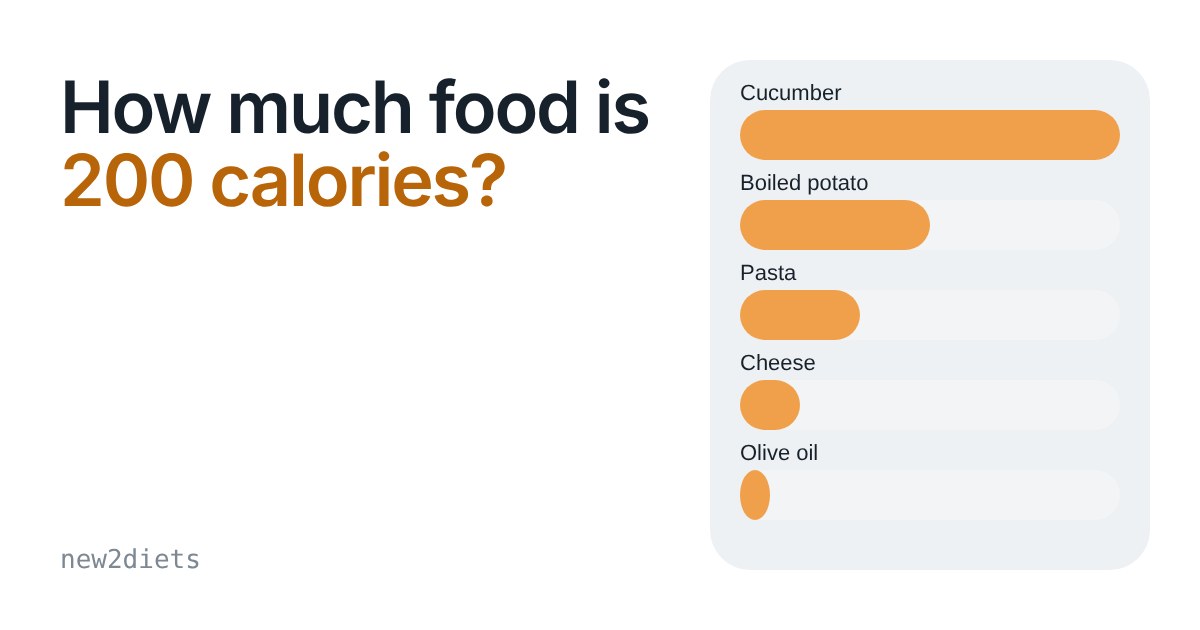
Same calories, very different amounts of food
A calorie is a unit of energy, and every food has some. What differs hugely is how much food you get for them. 200 kcal is about 1,300 g of cucumber, or about 23 g of olive oil, which is not even two tablespoons. That ratio, calories per gram, is called energy density.
It matters because we tend to eat by volume and weight as much as by calories. A plate that is heavy with water and fibre fills you up on fewer calories. A plate that is mostly fat and little water does not. This guide lets you see the difference for yourself.
Why some foods are so light
The energy in food comes from fat, carbohydrate, protein and alcohol. On EU labels they are counted at about 9 kcal per gram for fat, 4 for carbohydrate, 4 for protein, 7 for alcohol and 2 for fibre. Water has none. So:
- Water adds weight and no calories. Fruit, vegetables, soups, yoghurt and cooked grains or pulses are all partly water. Rice and pasta roughly double or triple in weight when cooked, which is why cooked values look much lower than the numbers on a dry packet.
- Fibre adds bulk and few calories.
- Fat packs the most energy into the least food. That is not bad: nuts, olive oil and cheese bring nutrients and flavour. It just means small amounts go a long way.
Foods are not good or bad because of their density. Density just tells you how much of them fits in a given number of calories.
What the research says
Studies on energy density generally find that people who eat more low-density foods such as vegetables, fruit, pulses and soups tend to feel full on fewer calories, and the CDC has published guidance along these lines. The evidence is observational in places and not every trial agrees, so treat it as a useful rule of thumb rather than a law. Dense foods are also often the most enjoyable, and enjoying food is part of eating well.
Using it in real life
You do not need to avoid dense foods. A few easy ideas:
- Start a meal with a soup or salad, or fill half your plate with vegetables.
- Treat oils, nuts, cheese and chocolate as flavour: measure them the first few times so you know what 15 g really looks like.
- Pick fruit, pulses and potatoes when you want a lot of food for your calories.
- Do not cut dense foods out entirely. Nuts and olive oil are central to the Mediterranean pattern, for example.
Weighing food for a week is a good way to get a feel for this, and any kitchen scale will do. After that most people can estimate by eye.
Who should check first
This is general information, not medical advice, and no one needs to count every gram. If you have a health condition, are pregnant or breastfeeding, take medication (especially for diabetes or blood pressure), or have or have had an eating disorder, talk to a doctor or dietitian before changing how you eat. Weighing and counting food is not a good fit for everyone.