How much sugar is in your day? Count the spoonfuls and see
Health bodies say to limit free sugars: the sugar added to food and drinks, plus honey, syrups and fruit juice. The WHO says under 10% of your daily energy, with extra benefits below 5%; the NHS suggests about 30 g a day for adults.
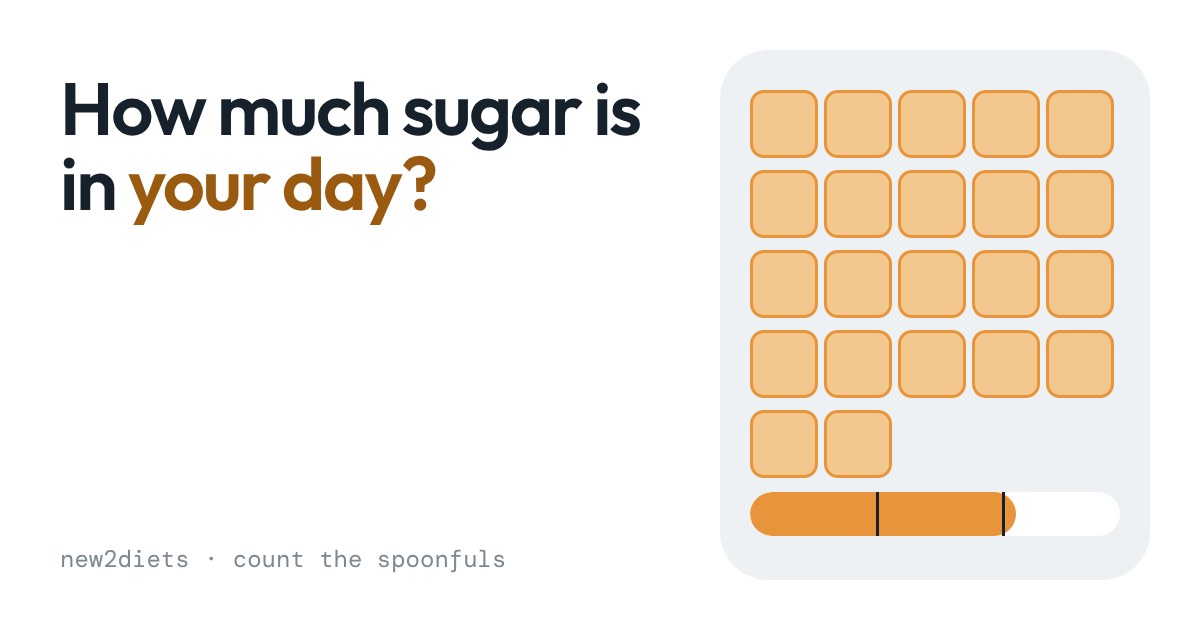
Tap through a typical day of drinks, snacks and sauces and watch the grams and teaspoons add up against those lines. Estimates only, and not medical advice.
"Sugar" on a label can mean two different things, and that is where most of the confusion starts. Total sugars include the sugar that is naturally inside whole fruit, vegetables and milk. Free sugars are the ones health bodies tell us to limit: sugar added to food and drinks, plus the sugar in honey, syrups and fruit juice. This guide is about the second kind.
What the guidelines say
The World Health Organization recommends that free sugars make up less than 10% of your daily energy, and says cutting to below 5% would bring extra benefits (that second step is a conditional recommendation, so the evidence is less firm). On a 2,000 kcal day, 10% is about 50 g and 5% is about 25 g. The NHS gives a simpler number for adults: no more than about 30 g a day. In 2022 the European Food Safety Authority did not set a safe upper limit; it said intake should be as low as possible within a nutritionally adequate diet.
So there is no single magic number, but the direction is the same everywhere: less is better, and most of us eat more than we think. A level teaspoon of sugar is about 4 g, which is a handy way to picture it.
Count your spoonfuls
Tap + for each thing you had in a typical day. Amounts are rounded, typical values; real products vary a lot, so check the "of which sugars" line on your own labels.
Most free sugar hides in drinks, sweet snacks and sauces, not in the sugar bowl.
Where it hides
A single can of cola can use up a whole day's 5% level. Fruit juice counts as free sugar even though it comes from fruit, because squeezing breaks the fruit open and leaves the sugar loose in the glass. Eating the whole fruit does not count: the sugar is held inside the fibre and cells. Milk and plain yoghurt also have natural sugars (lactose) that are not counted as free.
Savoury foods add more than you would guess: ketchup, pasta sauces, ready meals and "light" or low-fat products that make up for lost flavour with sugar.
How to read a label
- Look at the "of which sugars" line under carbohydrate. In the EU it does not separate added from natural sugars, so scan the ingredients too.
- Sugar goes by many names: glucose syrup, fructose, honey, agave, fruit concentrate, maltose. Anything ending in "-ose" is a sugar.
- Compare per 100 g. Roughly 5 g or less per 100 g is low; more than about 22 g per 100 g is high (UK traffic-light thresholds, widely used as a guide).
Easy swaps that don't feel like dieting
You do not need to cut sugar to zero, and you do not need to remove foods you enjoy. Small changes add up: water, sparkling water or unsweetened tea instead of a sweet drink; plain yoghurt with fruit instead of the flavoured pot; one teaspoon in your coffee instead of two. Sweeteners are a debated area, and the research is mixed, so they are an option, not a requirement.
Who should check with a professional
This is general information, not medical advice. If you have diabetes or another condition, are pregnant or breastfeeding, have or have had an eating disorder, or take medication (especially for diabetes or blood pressure), talk to your doctor or a registered dietitian before changing how you eat. Figures here are estimates for healthy adults; children have lower limits.