Why do some foods fill you up more? Compare 200 kcal of everyday foods
Two foods can both give 200 kcal and look nothing alike on the plate. This guide explains energy density, the calories in each gram of food, and lets you compare foods at the same energy to see how much of each you get.
We look at what the research does and doesn't show about fullness, why dense foods like nuts and olive oil still belong on a healthy plate, and three easy ways to use the idea. Not medical advice.
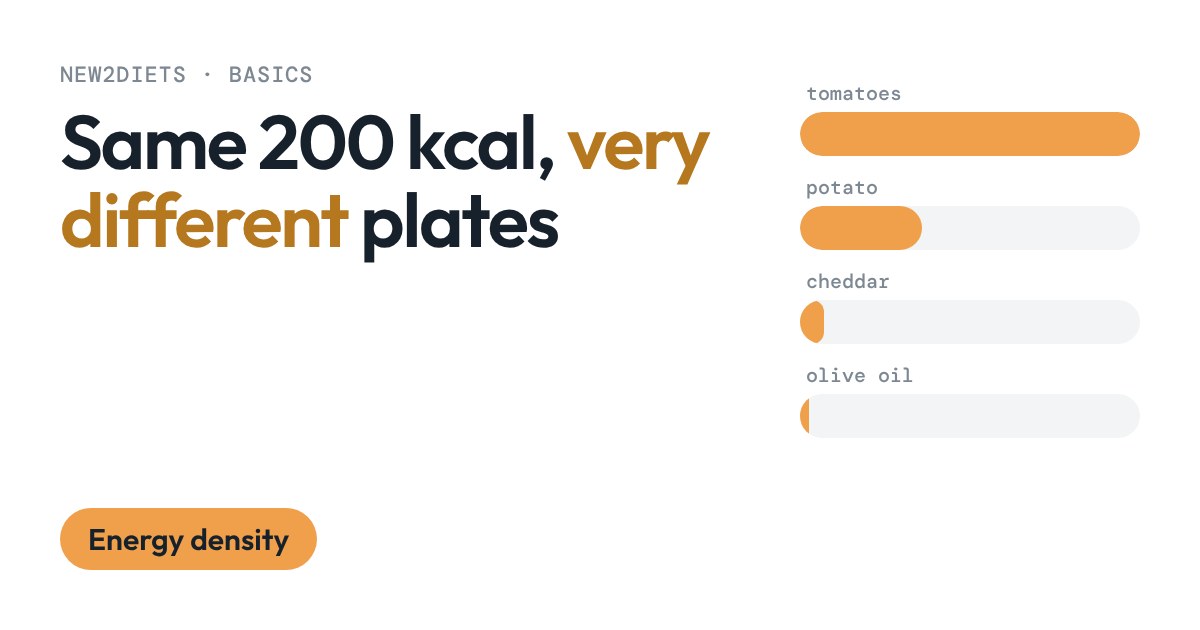
Why 200 calories can be a snack or a feast
A calorie is a unit of energy, and every food has some. What differs is how much food comes with those calories. A small handful of nuts and a big bowl of tomatoes can both be about 200 kcal, yet they feel nothing alike on the plate or in your stomach.
That difference has a name: energy density, the number of calories in each gram of food. Water has none and fibre has few, so foods full of water or fibre (vegetables, fruit, soups, cooked beans) are low in energy density. Oil, butter, chocolate, crisps and nuts are the opposite: little weight, many calories.
Same energy, very different amount of food. Foods with more water and fibre let you eat a bigger portion for the same calories.
Does it really make you feel fuller?
Partly. Short controlled feeding studies, many led by researcher Barbara Rolls, found that people tend to eat a fairly steady weight of food, so a meal made of lower-energy-dense foods usually ends up with fewer calories. Starting a meal with a soup or salad has also been linked to eating less of the rest. Longer trials, such as one year-long trial in women with obesity, found that adding fruit and vegetables led to more weight loss than cutting fat alone.
The evidence has limits. Most studies are small and short, some come from researchers who write books on the idea, and long-term effects are less clear. Treat it as a useful tool, not a law of nature.
Higher density isn't bad
Nuts, olive oil, cheese and avocado are dense, but they are also where much of the nutrition in a Mediterranean-style plate comes from. The point is not to avoid them, only to know that a spoonful of oil adds more energy than a whole plate of salad, so measure it. Dry, very processed foods such as crisps and biscuits are the ones that are easy to keep eating without feeling full.
Low density has a catch too: a very light diet can leave you short of energy and nutrients. Energy density tells you about the volume of a meal, not whether it has enough protein, fibre and fat to suit you.
Three easy ways to use it
- Add water-rich food. Extra vegetables in a pasta sauce, curry or stew make the plate bigger without changing much else.
- Start with soup or salad. Choose broth-based soup or a vegetable starter, and go light on creamy dressings.
- Measure the dense things. Oil, nuts, cheese and chocolate are worth a spoon or a small handful, not a guess.
When to check with a professional
This guide is general information, not medical advice. If you have a medical condition, are pregnant or breastfeeding, have or have had an eating disorder, or take medication (especially for diabetes or blood pressure), talk to a doctor or registered dietitian before changing how you eat. If paying attention to portions or calories makes you anxious, that is a good reason to ask for help rather than push on.