Per portion or per 100 g? Read a label and see which number to use
Per portion or per 100 g: which number should you trust? Both are true, but they answer different questions, and the portion on the pack is the maker's choice, not yours.
Pick an example product or type in the numbers from a pack, set how much you will actually eat, and see the calories, fat, sugars and salt for your portion, the low-to-high flags and the share of the reference intake. General information, not medical advice.
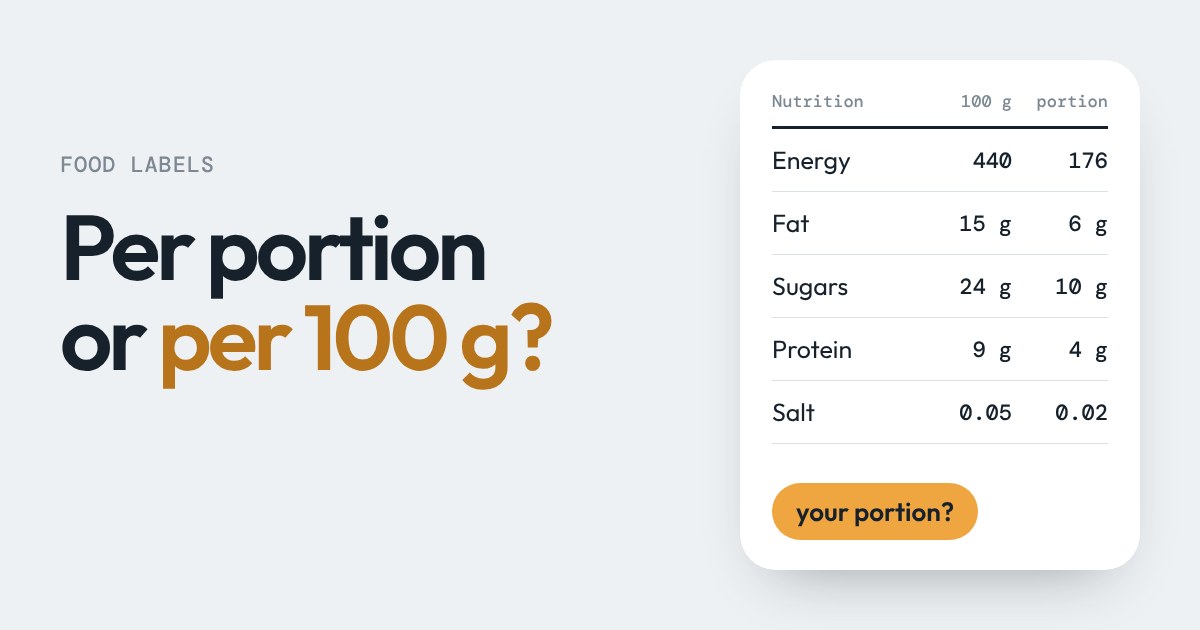
Pick up a packet and the front says "per portion" while the back says "per 100 g". Both columns are true, but they answer different questions. Knowing which one to use is the quickest way to stop being surprised by what you are actually eating.
Why there are two columns
In the EU and the UK, the nutrition table has to give amounts per 100 g (or per 100 ml for drinks). That is the same yardstick on every pack, so you can compare a cereal with a cereal bar fairly. Many products also show amounts per portion. That column is optional, and the manufacturer chooses the portion. The NHS points out that their idea of a portion may be quite different from yours.
A common trap: a granola "portion" of 40 g is a couple of spoonfuls, while a bowl is often double that. The per-portion column looks small, but your portion is the one that counts.
Try it: read a label
Pick an example product, or type your own per-100 g numbers from a pack. These are made-up example values, not real products. Then set how much you will actually eat and see what you get.
Use per 100 g to compare two foods. Use your own portion to know what you are eating.
The numbers worth knowing
The NHS describes a food as low or high per 100 g using these limits. Anything in between is medium.
- Fat: low is 3 g or less, high is more than 17.5 g.
- Saturates: low is 1.5 g or less, high is more than 5 g.
- Sugars: low is 5 g or less, high is more than 22.5 g.
- Salt: low is 0.3 g or less, high is more than 1.5 g.
The percentage column uses the EU and UK reference intakes for an average adult: 2000 kcal, 70 g fat, 20 g saturates, 260 g carbohydrate, 90 g sugars, 50 g protein and 6 g salt. They are based on an average woman's needs and are for guidance only. Children need less, and many adults need more or less than 2000 kcal, so treat the percentages as a way to size things up, not as a score to hit.
Two small translations help. Energy appears twice, in kilojoules (kJ) and kilocalories (kcal), and "calories" in everyday talk means kcal; 1 kcal is about 4.2 kJ. And if a label gives sodium instead of salt, multiply by 2.5 to get salt.
Check the maths yourself
Energy on a label is worked out from what is in the food. Under EU rules, each gram of fat counts as 9 kcal, and each gram of carbohydrate or protein as 4 kcal. Fibre counts as 2 kcal. That is why the tool above adds a rough check under the table: if the numbers are far apart, you may have mistyped one. Small gaps are normal because of fibre and rounding.
Where labels fall short
A label gives averages, and the true values can differ a little from pack to pack. The "sugars" line is total sugars, which includes those naturally in milk and fruit, so a fruit yoghurt will flag higher than a plain one even before anything is added. The high and low limits are for judging foods, not clinical limits for a person, and drinks use different criteria than the ones listed here. None of this tells you whether a food is "good" or "bad": a high-fat food such as olive oil or nuts can be a sensible part of eating well in small amounts.
A simple way to start
Next time you shop, pick one food you buy often and look at the per 100 g column, then at the weight you really serve. Compare two similar products on per 100 g. You do not need to do this for everything. If you have a health condition, are pregnant or breastfeeding, take medication (especially for diabetes or blood pressure), or have or had an eating disorder, talk to a doctor or dietitian before changing how you eat. This guide is general information, not medical advice.