What does BMI actually tell you? Put in your numbers and see what it misses
BMI is one quick number that health bodies use to screen groups of people. It can't tell muscle from fat, and it can't see where fat sits.
Put in your height and weight, and an optional waist measurement, to see your BMI, the ranges used by the WHO and NICE (including the lower ones for some backgrounds), and the waist-to-height ratio. It's a screening estimate, not a verdict or a medical opinion.
One number, two questions
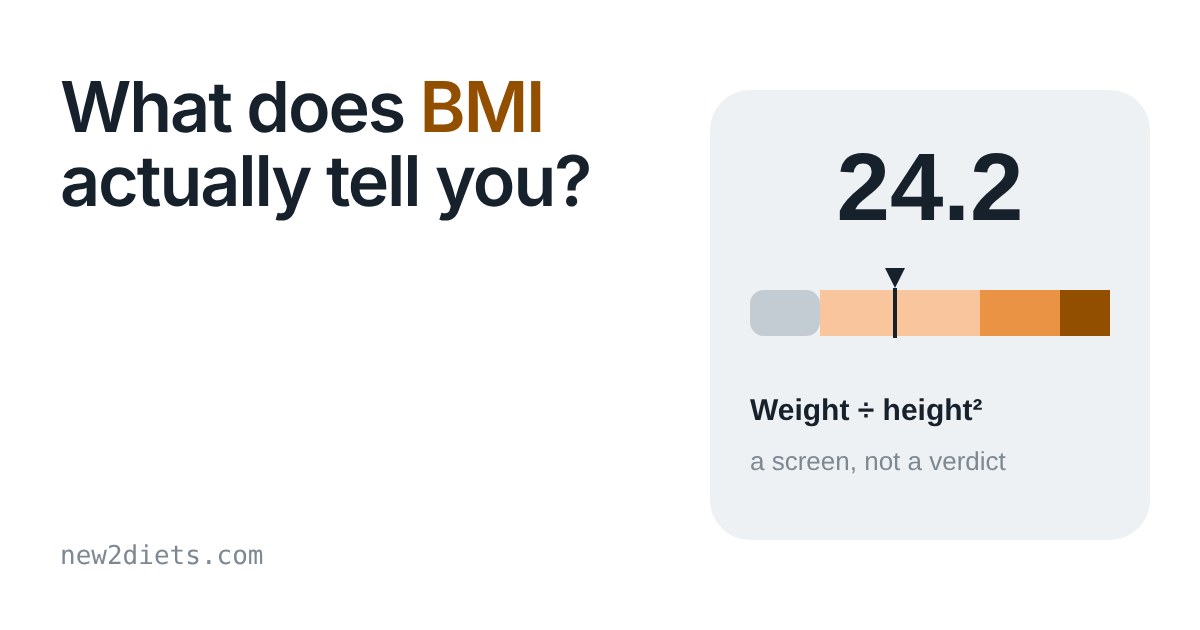
Body mass index (BMI) is a quick sum: your weight divided by your height squared. Health bodies use it to screen a population, a bit like a first filter. It says nothing about what you eat, how fit you are or how you feel, and it cannot tell muscle from fat. Try it below, then see what it misses.
BMI is a screening number, not a verdict on your health or on you.
What the ranges mean
For adults, the standard ranges used by the WHO and by national health services are: under 18.5 is the underweight range, 18.5 to 24.9 the healthy-weight range, 25 to 29.9 the overweight range and 30 or more the obesity range. They were set because, across large groups of people, health risks such as type 2 diabetes and heart disease tend to rise as BMI climbs. That is a pattern across populations. It does not predict what will happen to one person.
The ranges also differ by background. For people of South Asian, Chinese, other Asian, Middle Eastern, Black African or African-Caribbean origin, UK guidance (NICE) uses lower points, 23 and 27.5, because risks such as type 2 diabetes appear at lower BMI in these groups. That is why the calculator lets you switch.
What BMI misses
- Muscle versus fat. Muscle is denser than fat, so a strong, active person can have a high BMI with little excess body fat.
- Where fat sits. Fat around the middle is linked with more risk than fat on the hips and thighs. BMI cannot see where it is.
- Age and frame. BMI can be less reliable for older adults, who lose muscle, and for very tall or very short people.
- Everything else. What you eat, how you sleep and move, your blood pressure and blood sugar, and your mental health all matter more than one ratio.
Why waist-to-height helps
Measuring your waist adds the one thing BMI cannot see. Divide your waist by your height (both in cm). NICE's current guidance suggests keeping your waist to less than half your height, a ratio under 0.5. Measure halfway between the bottom of your ribs and the top of your hips, breathing out normally and not pulling the tape tight. It is a screening tool too, and it is designed for people with a BMI under 35.
What to do with your result
Treat it as a starting point for a conversation, not a goal. If your numbers are in the usual range, there is nothing to fix. If they are above it, small, steady changes (more vegetables and fibre, more walking, regular meals) matter more than any target, and a GP or dietitian can set a plan that fits your health. If your BMI is below 18.5, or you are worried about your relationship with food, speak to a professional too.
This is general information, not medical advice. If you have a condition, are pregnant or breastfeeding, have or had an eating disorder, or take medication, talk to a doctor before changing how you eat. Please avoid crash diets or very low-calorie plans.