Do you burn calories digesting food? Set your day's mix and see how much
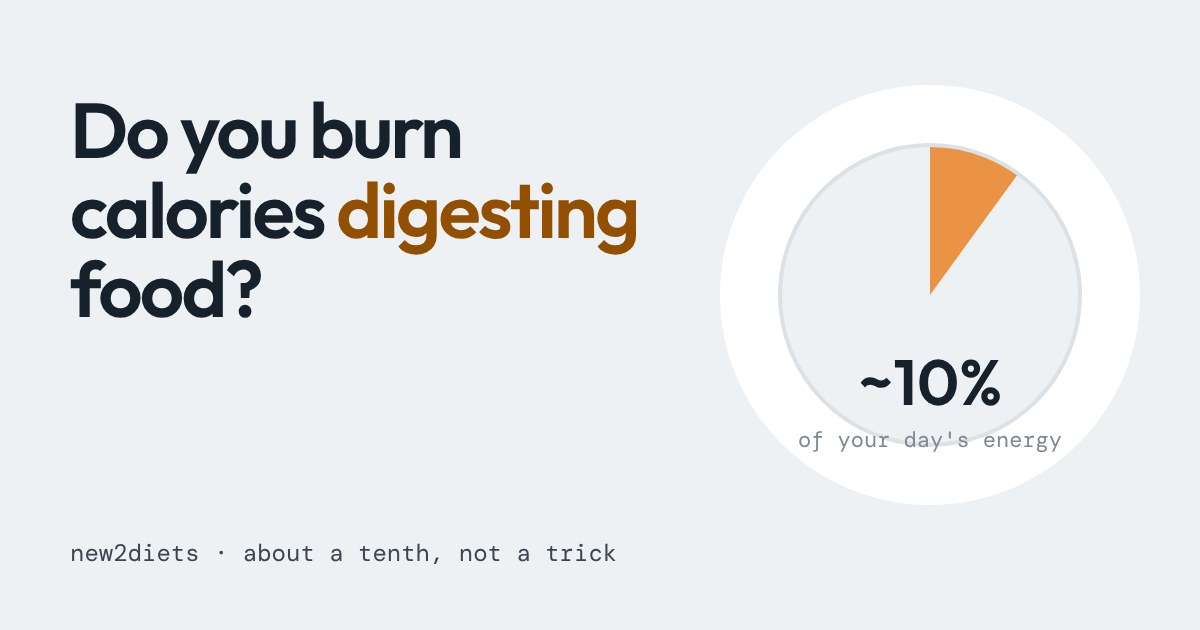
Your body spends some energy digesting, absorbing and storing every meal. That is the thermic effect of food, and it is real but small: roughly a tenth of your day's energy on a normal mixed diet.
Set your calories and the split between protein, carbs and fat, and see how many kcal it comes to, why protein sits at the top, and why it is not a trick or a reason to eat differently.
Do you burn calories just by digesting food?
Yes, a little. Chewing, digesting, absorbing and storing food all take energy, so your body uses up part of every meal just to deal with it. This is called the thermic effect of food (the extra heat your body gives off after you eat). It is real, and it is also small. People sometimes talk about it as if it were a hack. It is closer to a rounding error.
Set a day of eating below and see how much it comes to.
What the research says
A review of the research by Klaas Westerterp puts the thermic effect at roughly 10% of your daily energy use when you eat a normal mixed diet, with a range of about 5–15%. It also found that it is not the same for every nutrient. As a share of the energy in the food itself:
- Protein: about 20–30% is used up digesting it.
- Carbohydrate: about 5–10%.
- Fat: about 0–3%.
That is why protein comes out on top and fat last. It is also why a day of mixed meals lands near 10% overall.
The research is less tidy than those ranges suggest. Measurements of the same person on different days can vary a lot, and the link between a higher protein share and a higher thermic effect was weak in the review's comparison of 19 studies. Treat the numbers above as averages, not as your own number.
Why it is not a trick
Move the protein slider and watch the result. At 2000 kcal, shifting ten percentage points of your calories from carbs to protein changes the estimate by about 35 kcal. That is roughly a small biscuit. Protein has other good reasons to be on your plate, but this is not one worth building a day around.
The same ranges explain why "negative-calorie" foods do not exist. Even the most demanding nutrient, protein, gives back at most 20–30% of its calories as heat. Celery cannot cost you more energy than it supplies.
Two more things worth knowing:
- It is already counted. Estimates of how many calories you need in a day are built to include it. Do not add it on top, and do not try to "eat back" extra.
- Labels do not subtract it. Food labels use fixed values per gram, so the calories on the pack are what the food contains, not what is left after digestion.
Digesting food uses about a tenth of what you eat. It is already in your numbers, so there is nothing extra to chase.
What to do with this
Nothing needs to change. Choose meals you enjoy, that fill you up and give you a mix of nutrients, and let the thermic effect take care of itself. If you want to know how many calories fit your day, use a calculator that gives a range, and remember that every estimate is out by 10% or more.
This guide is general information, not medical advice. If you have a medical condition, are pregnant or breastfeeding, have or have had an eating disorder, or take medication (especially for diabetes or blood pressure), talk to a doctor or dietitian before you change how you eat. People with kidney conditions in particular are often given specific advice about protein.
Sources
- Westerterp KR. Diet induced thermogenesis. Nutrition & Metabolism 2004;1:5. Review of the size of the thermic effect, its range by nutrient and its variability.