Does one big meal undo your week? Slide your days and see the weekly average
Does one big meal, or one big Saturday, undo your week? Not by itself. Your body responds to the total over days and weeks, and one day is only a slice of that.
Slide each day of the week up or down, try four example weeks, and see your weekly total, your daily average and how it compares with your own need, including the margin of error on that estimate. Plus what research on weekend eating and the weekly weight rhythm actually found.
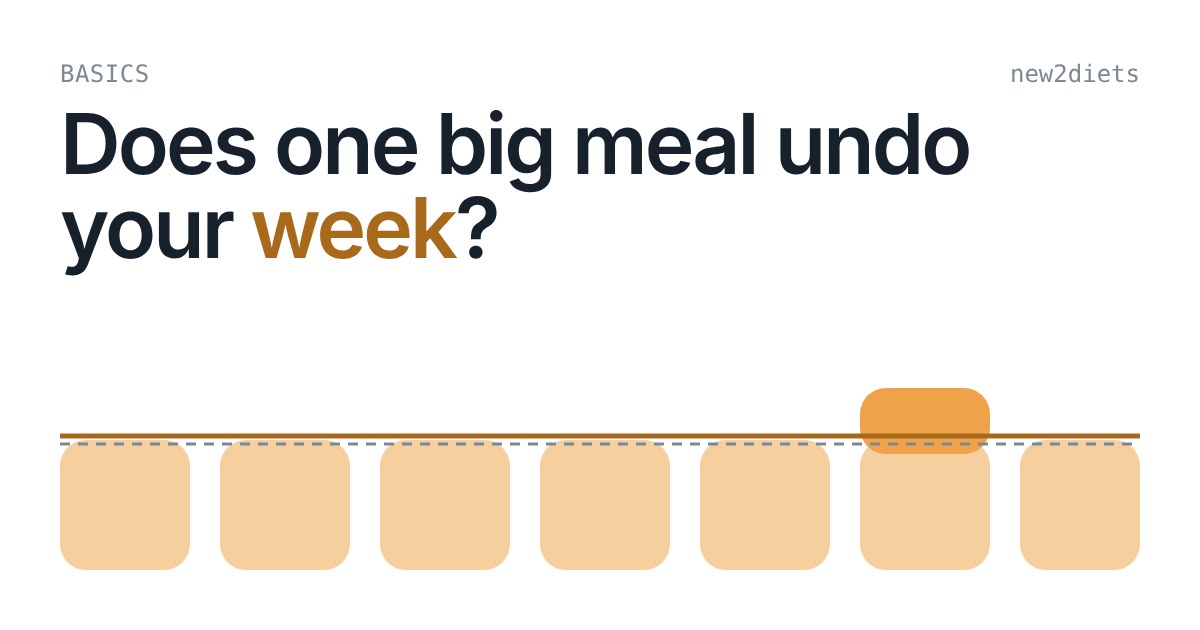
You had a big Saturday: a long dinner, dessert, a few drinks. Now it feels like the whole week is ruined. Is it? The short answer is that your body does not reset at midnight. Over days and weeks, what matters most is the total energy you eat and drink compared with what you use, and one big day is only one-seventh of that total.
A day is a slice of the week
A calorie (kcal) is a unit of energy. Public health bodies such as the NHS give rough guides of about 2,000 kcal a day for an average woman and 2,500 kcal for an average man, and say your own needs depend on age, size and how active you are. Those figures describe a typical day, but nobody eats the same amount every day.
If you need about 2,000 kcal a day, your week needs about 14,000. A Saturday that runs 1,000 kcal over adds about 7% to that week, and it is a one-off, not a new habit. Eating a bit less or a bit more on other days moves the total back or further away.
Your body responds to what you eat over days and weeks, not to one meal or one day.
What the research says
Two studies show why a single day is the wrong unit. In one, researchers followed 80 adults and analysed more than 4,600 daily weigh-ins. Weight followed a weekly rhythm: highest on Sunday and Monday, then falling through the weekdays. The authors concluded that weekend-to-weekday swings are normal and should not be read as gain on their own.
The same rhythm can still add up. In a year-long study of 48 adults aged 50 to 60, people ate the most on Saturdays. For those on a calorie-reduction plan, that stopped weight loss at weekends even though they lost during the week. The researchers estimated that eating like that every weekend, with nothing else changing, could add roughly 4 kg (9 lb) over a year. So one big Saturday is not the problem; a Saturday that is big every single week is a pattern worth noticing.
A third piece of evidence points the same way. A review of 11 randomised trials, lasting 8 to 24 weeks, found that eating less on some days and normally on others led to weight loss similar to eating a little less every day. That suggests the total counts for more than the exact pattern. The trials were short, though, and the authors say longer ones are needed, so this is a hint rather than proof.
How to use this
- Think in weeks. If you want to know how your eating is going, look at several days together, not at one meal.
- Don't skip meals to "make up" for a big day. Go back to your normal meals the next morning. Long gaps and very small days can make hunger harder to manage, and the sliders above warn you below the minimums.
- Expect the scale to move. A heavier Sunday or Monday often reflects food and water still in your system, not new body fat, as the weekly-rhythm study suggests.
- Notice habits, not slips. If every weekend is much bigger than the weekdays, that is the thing to adjust, gently, not any single dinner.
This guide is general information, not medical advice. If you have a medical condition, are pregnant or breastfeeding, take medication (especially for diabetes or blood pressure), or have or have had an eating disorder, talk to a doctor or dietitian before changing how you eat. If cycles of eating a lot and then cutting back feel out of your control, that is also a good reason to ask for support.
Sources
- NHS: What should my daily intake of calories be?
- Orsama et al., Weight rhythms: weight increases during weekends and decreases during weekdays (Obesity Facts, 2014)
- Washington University: weekend eating slows weight loss (Racette et al., Obesity, 2008)
- Cioffi et al., Intermittent versus continuous energy restriction: systematic review and meta-analysis (J Transl Med, 2018)