Budget
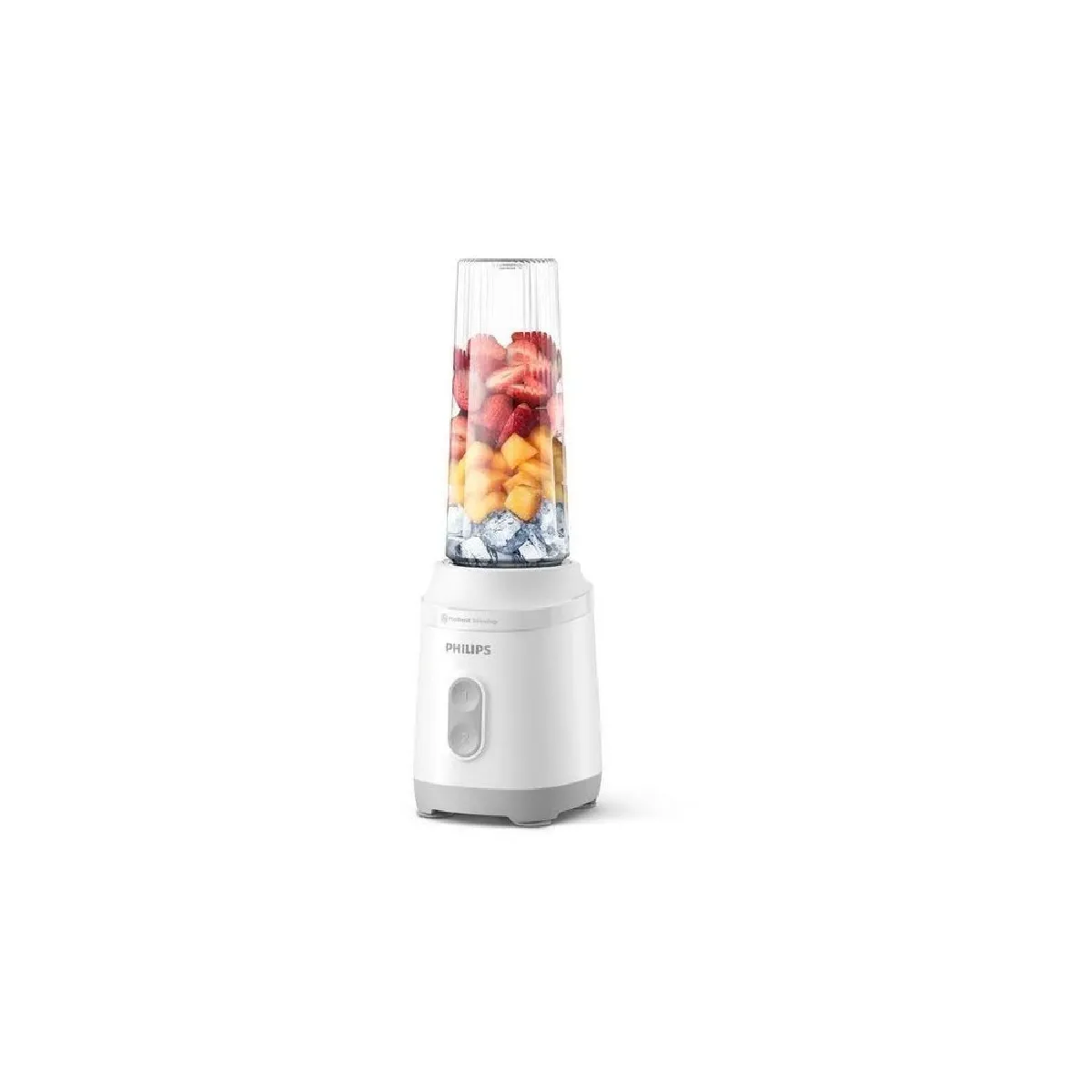
Blender - PHILIPS - HR2670/00 - 350 W - 0,8 L - Noir
A small jug is enough for the single smoothie the guide suggests having with a meal, and a plain design is easy to rinse and put away.
350 W motor0.8 L jug
Blending doesn't remove fibre or add calories, so a smoothie is a fair way to eat fruit. But it is not the same as the fruit bowl. The NHS counts the sugars in blended fruit as free sugars, and a smoothie only counts once towards your 5 a day.
Build your own below and flip between blended and whole to see what changes, then check what matters in a blender.
A smoothie feels like the healthy shortcut: fruit, a handful of greens, done in a minute. Whether it is as good as eating the same fruit depends on what goes in the glass and how big the glass is. The calories and most of the fibre survive the blender. What changes is how your body, your teeth and your appetite treat it.
Blending does not delete fibre and it does not add calories. A banana, a handful of strawberries and some oats have the same energy in the glass as on the plate. Switch the toggle above and watch: the kcal and fibre tiles stay put.
The sugar line moves, though. The NHS says that crushing fruit and vegetables into juices and smoothies releases the sugars they contain, which can damage teeth, and it counts unsweetened smoothies as free sugars. The sugar in a whole banana is not counted as free sugar, the same sugar in a blended banana is. The World Health Organization also advises keeping free sugars under 10% of daily energy, which is about 50 g on 2,000 kcal; the NHS gives adults a lower practical cap of 30 g.
One portion of fruit or vegetables is 80 g. Eat three portions as whole food and they count as three. Drink them as a smoothie and the NHS counts the lot as one, however much you put in, and advises keeping juice and smoothies to a combined 150 ml a day, ideally with a meal rather than sipped all afternoon. A big glass of blended food is easy to finish quickly, and the rule is there to keep that in check.
A smoothie is fine as a drink with a meal. It just can't do the job of the fruit bowl.
Probably less. In a study with 58 adults, people ate a whole apple, applesauce or apple juice, each with about the same energy, before lunch. The whole apple was the most filling and led to the lowest total energy eaten at lunch; applesauce came second and the juices last. A smoothie is closer to applesauce than to juice, but it is one study, and researchers say more work is needed on why form matters. Adding oats, yoghurt or nut butter makes a smoothie more filling, and also more calories, so try it with the buttons above.
If you do make smoothies or soups often, a few things matter more than a headline wattage number:
This guide is general information, not medical advice. If you have a condition such as diabetes, are pregnant or breastfeeding, have or have had an eating disorder, or take medication, talk to your doctor or a registered dietitian before changing how you eat. A smoothie should add to a varied diet, not replace meals as a rule.
Affiliate links, marked sponsored. We may earn a commission at no extra cost to you. Examples that match this guide, not tested reviews. Prices checked 8 Oct; every shop is on each product page.
A small jug is enough for the single smoothie the guide suggests having with a meal, and a plain design is easy to rinse and put away.
More motor for fibrous greens and frozen fruit, plus a pulse button for short bursts, so oats and spinach blend smoothly.
A large glass jar suits batches of soup or family-sized smoothies, and the extra power copes with ice and nuts.
