How much salt is in your day? Tap your foods and see
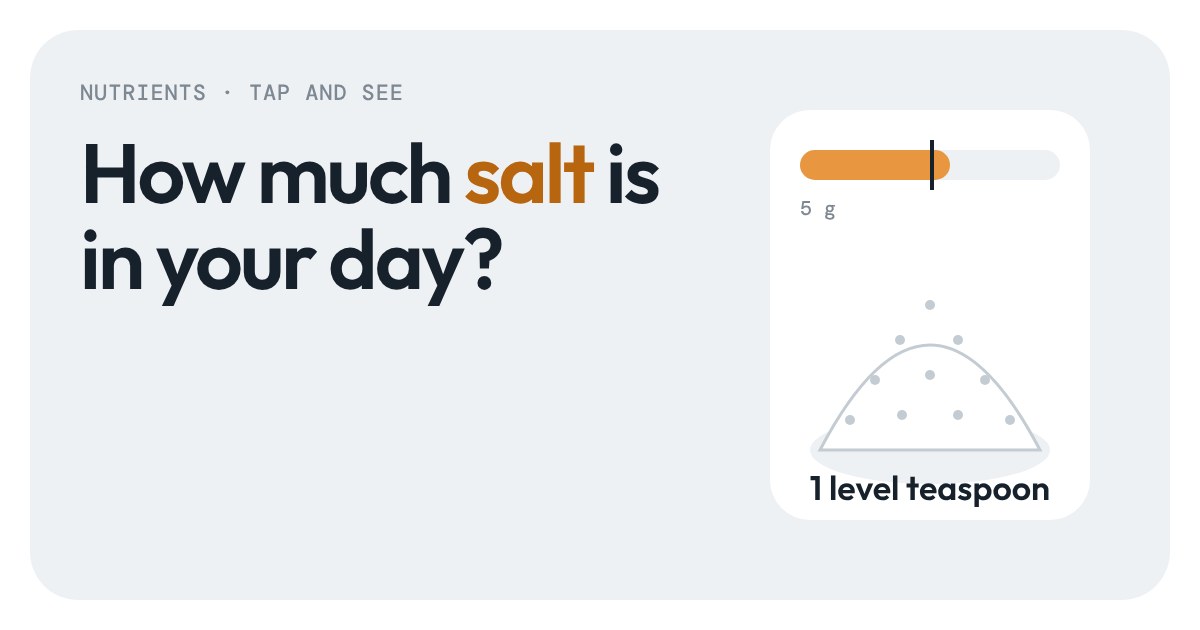
Most of the salt we eat is already in the food we buy, not in the shaker. The WHO says adults should have less than 5 g of salt a day (under 2,000 mg of sodium); the NHS says no more than 6 g.
Tap through a typical day of bread, meat, soups, sauces and ready meals and watch the grams add up against those lines. Estimates only, and not medical advice: if you have high blood pressure, a heart or kidney condition or take medication, ask your doctor first.
Salt is the one nutrient most of us eat too much of without ever reaching for the shaker. In the UK about three quarters of the salt we eat is already in food when we buy it, and the WHO estimates the world average is more than double its limit. This guide shows where it hides, using a typical day you can build yourself.
What the guidelines say
Labels in the EU list salt, but some still show sodium, the part of salt that matters for blood pressure. The two are easy to convert: salt = sodium × 2.5. So 400 mg of sodium is 1 g of salt.
The World Health Organization recommends adults eat less than 2,000 mg of sodium a day, which is less than 5 g of salt, or just under a level teaspoon. The European Food Safety Authority (EFSA) set a "safe and adequate intake" of 2.0 g of sodium a day for EU adults, which is the same amount. The NHS in the UK says adults should have no more than 6 g of salt a day, about one level teaspoon. Those numbers differ a little, but the direction is the same, and the WHO reports a global average of about 11 g a day. Children need less: the NHS gives 2 g for ages 1 to 3, 3 g for 4 to 6 and 5 g for 7 to 10.
Build your day
Tap + for each thing you ate in a typical day. Amounts are rounded, typical values; brands vary a lot, so your own labels beat these numbers.
Most of your salt comes from bread, meat, sauces and ready meals, not from the shaker.
Where it hides
Bread is a good example. One slice does not look salty, but eaten at several meals it adds up, and it is one of the biggest sources in many diets. Cured meat (ham, bacon, salami), cheese, soups, sauces, stock cubes, pizza and ready meals are the others. The WHO also lists soy sauce and fish sauce as high-sodium condiments. Naturally, milk, meat and shellfish contain some sodium, but far less than most processed foods.
It does not mean these foods are off the menu. It means brand differences matter: two tins of soup can differ by a factor of two.
How to read a label
- Look for salt per 100 g. If a label shows only sodium, multiply by 2.5.
- As a guide (UK traffic-light thresholds), 0.3 g of salt or less per 100 g is low and more than 1.5 g per 100 g is high.
- Compare per 100 g between brands, then think about how much you actually eat. A pizza is far more than 100 g.
Small changes that work
Taste adjusts over a few weeks, so you do not need to give up flavour. Try a lower-salt bread or soup, season with herbs, lemon, garlic, pepper or spices, rinse tinned beans and vegetables, and taste before you add salt. The WHO also suggests that a lower-sodium salt substitute containing potassium can help in some cases, but that is something to ask your doctor about first, because potassium is not right for everyone, for example with kidney disease or some blood pressure medicines.
Who should check with a professional
This is general information, not medical advice. If you have high blood pressure, heart or kidney disease, diabetes or another condition, are pregnant or breastfeeding, have or have had an eating disorder, or take medication (especially for diabetes or blood pressure), talk to a doctor or registered dietitian before changing how you eat. Do not cut salt out entirely; sodium is a nutrient we need in small amounts. Figures here are estimates for healthy adults; children need less.