Is 16:8 fasting better than just eating less? Slide the window and see
Is 16:8 fasting better than just eating less? Trials so far, including a 2022 NEJM trial and a 2026 Cochrane review, suggest the clock itself adds little: what matters is whether the window leads you to eat a little less.
Slide the eating window and the calories you actually eat to see what changes the daily gap. Not medical advice; talk to a doctor or dietitian first if you have a condition, take medication, are pregnant or have had an eating disorder.
Is 16:8 fasting better than just eating less?
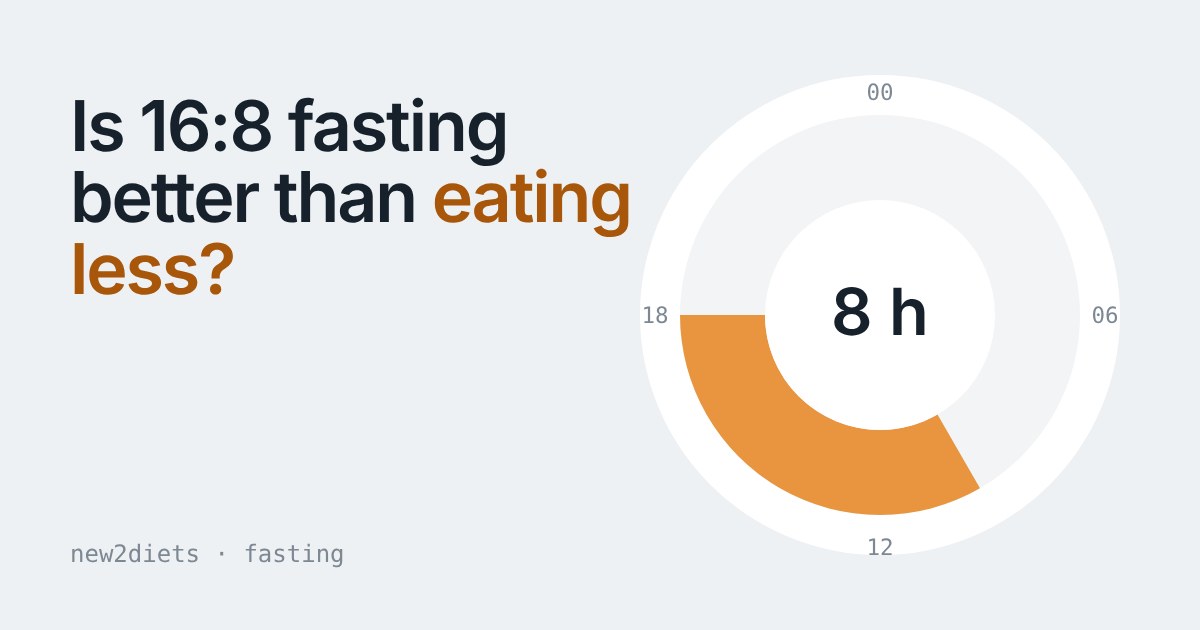
16:8 means you eat during an 8-hour window and fast for the other 16, usually including sleep. It is one of the most popular ways to eat, and it often comes with a big promise: that the clock does something special that ordinary eating less does not. So what does the research say when the two are put side by side?
The short version: for weight, the evidence so far says the clock is not magic. What matters is whether the window leads you to eat a little less than you otherwise would. If it does, it can be a handy structure. If it does not, nothing changes.
What the trials found
In 2022 a randomised trial in the New England Journal of Medicine followed 139 adults for 12 months. Everyone followed a calorie-reduced plan. One group also ate only between 08:00 and 16:00. After a year both groups had lost weight (about 8 kg with the window, about 6.3 kg without), but the gap between them was small enough that it could be chance (P = 0.11).
A larger look came in February 2026, when a Cochrane review pooled 22 trials with almost 2,000 adults. Compared with ordinary calorie-reduced advice, intermittent fasting gave about the same weight loss (a difference of -0.33%, with a confidence range that includes zero). Compared with doing nothing it did better, but by an amount the authors judged unlikely to matter much. The certainty of the evidence was low to moderate, most trials lasted 6 to 12 months, and the authors asked for longer, better trials. Experts commenting on the review also pointed out that the trials mix different kinds of fasting and are fairly small, so treat the result as "no clear advantage", not as proof that nothing could ever differ.
The window changes when you eat. Only your calories change how much you eat.
Try it: the clock and the gap
Enter what you usually eat in a day, then slide the eating window and how much less you end up eating. Try the three presets to see the point.
Why people still like it
None of this means 16:8 is pointless. For some people a clear rule is easier than counting: no late-night snacking, a set breakfast or dinner time, fewer decisions. If that helps you eat a little less without feeling miserable, that is a real benefit. If you find yourself overeating inside the window, getting headaches or dizzy, or thinking about food all day, it is not working for you, and eating regular meals is just as good.
Bear in mind the research is mixed. Studies are mostly short, small and vary in how they define fasting, and they say little about long-term health beyond weight. Whichever you choose, the thing to protect is the quality of what you eat: enough protein, fibre, fruit and vegetables.
Who should check first
Fasting is not for everyone. If you have a medical condition, take medication (especially for diabetes or blood pressure), are pregnant or breastfeeding, are under 18, or have or have had an eating disorder, talk to a doctor or dietitian before changing when you eat. Do not eat below public minimum intakes (around 1,200 kcal for women and 1,500 kcal for men) and avoid crash diets: a small, steady change you can keep up beats a harsh one you cannot.
Sources
- Liu et al., New England Journal of Medicine (2022): Calorie restriction with or without time-restricted eating in weight loss
- The same trial on PubMed
- Cochrane review "Intermittent fasting for adults with overweight or obesity" (February 2026), with expert reactions
This guide is general information, not medical advice.