How does 5:2 fasting actually work? Pick your two lighter days and see your week
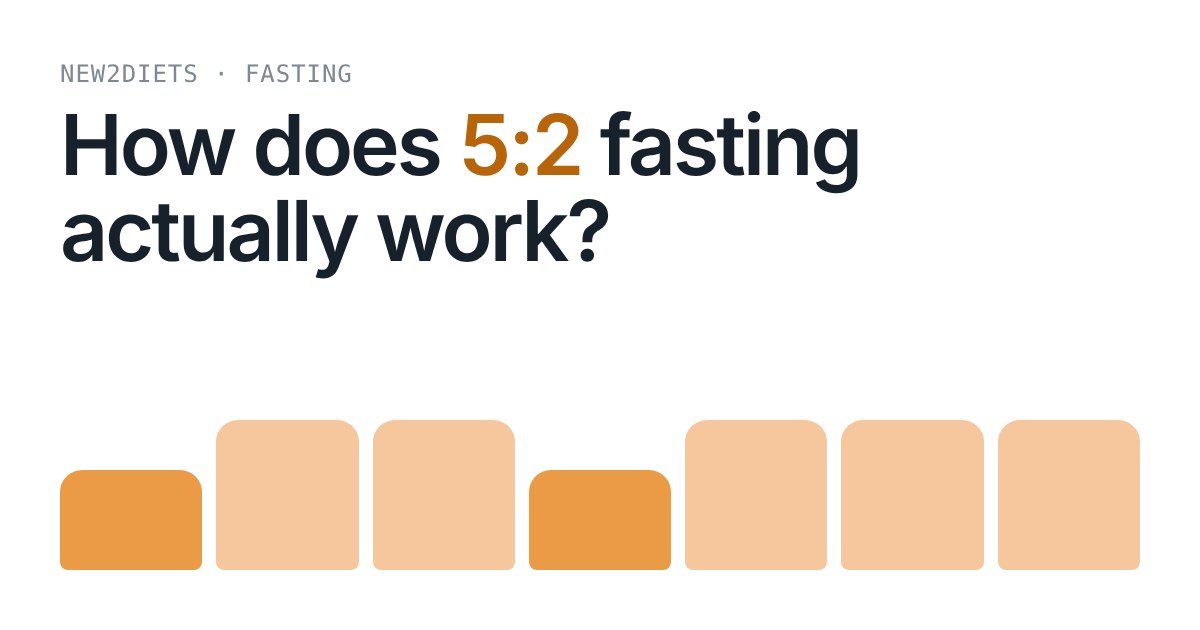
The 5:2 pattern means eating as usual five days a week and eating less on two days that are not back to back. Pick your two days and see how your week looks, using a gentler version that never drops below the 1200 kcal (women) or 1500 kcal (men) minimum.
Research so far finds it works about as well as eating a little less every day, not better. We explain who should skip it and why the weekly total is what counts. Not medical advice.
What 5:2 actually means
The 5:2 pattern is simple to say: eat as usual on five days of the week and eat noticeably less on two days that are not back to back. It is one of several ways of "intermittent fasting", but unlike 16:8 it does not change when you eat during the day. It changes how much you eat on certain days.
The version studied in trials is strict. On the two "fast" days people ate roughly a quarter of their usual energy needs, which a 2018 review of trials set at no more than about 500 kcal for women and 660 kcal for men. That is well below what this site suggests for anyone, so the planner below does not go there. It shows a gentler version: two lighter days, never under the minimum for adults of 1200 kcal (women) or 1500 kcal (men), and it shows what that does to your week.
How the numbers work
The estimate uses the Mifflin-St Jeor equation: resting energy = 10 × weight (kg) + 6.25 × height (cm) − 5 × age + 5 for men or − 161 for women. That is multiplied by an activity factor (1.2 for mostly sitting up to 1.725 for very active). It is a population average, not a measurement of you.
Notice what the chart shows. Two lighter days only pull your weekly average down by a modest amount, because the other five days stay at your usual level. The weekly average is what counts for energy balance, not any single day. That is why the evidence below looks the way it does.
What the research says
A 2018 meta-analysis of eleven randomized trials (8 to 24 weeks long) compared intermittent restriction, including 5:2 patterns, with eating a bit less every day. Weight loss was comparable between the two, with a pooled difference of about 0.6 kg that was not statistically significant. A 2026 Cochrane review of 22 trials in adults with overweight or obesity found intermittent fasting was a possible option but not clearly better than regular dietary advice, and the certainty of the evidence was low.
So the honest summary is: 5:2 can work for some people and is not magic. If the pattern fits your week, it is a fair choice. If it leaves you tired, hungry or thinking about food all day, eating a little less every day gets you to the same place.
Pick the pattern you can keep up. Over a week, the total matters more than the shape.
Who should not try it
Skip 5:2 and talk to a doctor or dietitian first if you are under 18, pregnant or breastfeeding, have or have had an eating disorder, have diabetes or take medication (especially insulin, or tablets such as sulphonylureas, which can raise the risk of low blood sugar on lighter days), have a medical condition, or are underweight. Diabetes UK's guidance says the same about eating disorders, pregnancy and diabetes medication. This guide is not medical advice.
Making a lighter day work
- Protein and fibre at every meal. Eggs, yoghurt, beans, lentils, fish or tofu with vegetables keep you fuller on fewer calories.
- Drink water, tea or black coffee between meals.
- Do not make up for it the next day. Eating a very big meal after a lighter day cancels the point of it.
- Keep hard training for usual days. Put your toughest sessions on the days you eat as normal.
- Stop if it goes badly. Dizziness, faintness, headaches, or a preoccupation with food are signals to go back to regular meals and speak to a professional.
Sources
- Cioffi et al. 2018, J Transl Med: intermittent versus continuous energy restriction, meta-analysis of randomized trials
- Garegnani et al. 2026, Cochrane Database of Systematic Reviews: intermittent fasting for adults with overweight or obesity
- Know Diabetes (NHS-linked, with British Dietetic Association comment): intermittent fasting
- Mifflin et al. 1990, Am J Clin Nutr: a new predictive equation for resting energy expenditure