How often should you eat beans and lentils? Plan your week and see
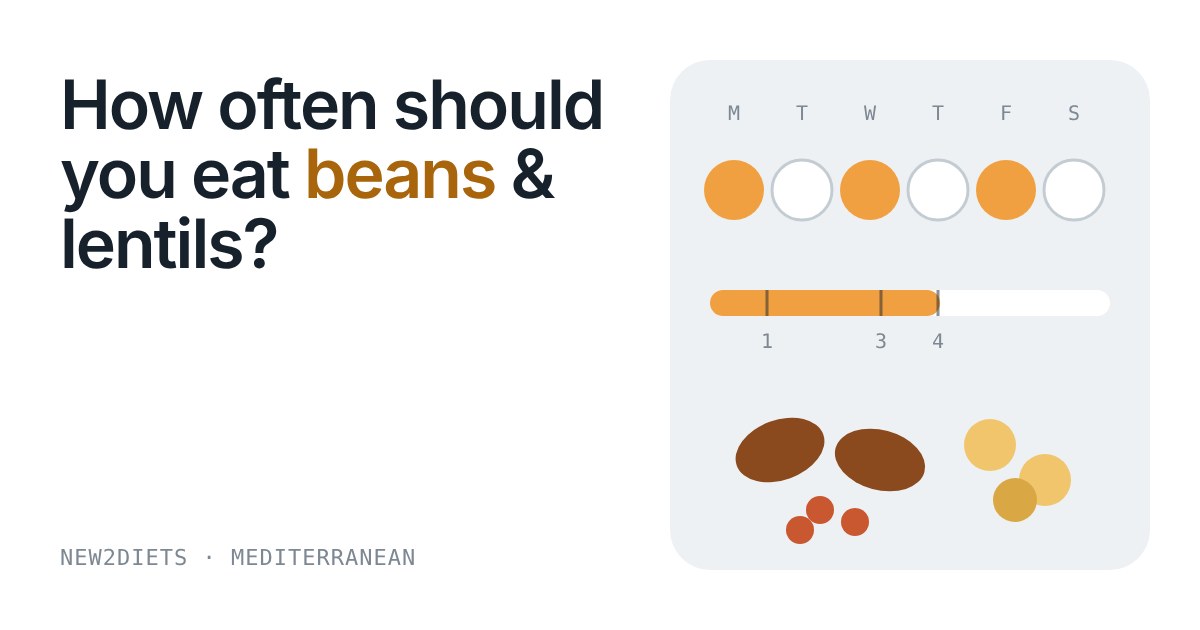
How many times a week should beans and lentils be on your plate? Italy's guidelines suggest about 3 servings a week, Spain's at least 4, and the Dutch and Belgian ones at least once.
Plan your own week day by day and see the fibre, protein and calories pulses add, with the sources behind each number. General information, not medical advice.
Beans and lentils are the quiet star of the Mediterranean plate
Olive oil and fish get the attention, but in traditional Mediterranean cooking the everyday workhorses are pulses: lentils, chickpeas and beans. They are cheap, they keep for months and they give you protein and fibre in the same spoonful. The question beginners ask is simple: how many times a week is enough?
There is no single answer, because countries word it differently. Italy's guidelines suggest about 3 servings of pulses a week, Spain's say at least 4, and the Dutch and Belgian guidelines ask for at least once a week. So the useful target is a range: from once a week as a floor, up to most days if you enjoy them.
What counts as a serving
Guidelines measure servings differently, so here is a practical version. About 150 g cooked is roughly half a standard tin, drained, or a generous ladle of lentil soup with the lentils included. Dried pulses roughly double or triple in weight when cooked, so 50–70 g dry gives about that much.
Tinned, dried, frozen and jarred all count. Tinned are the easiest for beginners: rinse them, and pick ones in water without added salt or sugar where you can. If you cook dried kidney beans yourself, soak them and boil them hard for at least 10 minutes first; undercooked kidney beans can make you ill.
What you get for it
Per 100 g cooked, lentils and chickpeas each give about 9 g of protein and 7–8 g of fibre, for roughly 115–165 kcal. The NHS says pulses are a good source of fibre and that some fibre from foods like pulses may help reduce blood cholesterol. UK guidance asks adults to reach 30 g of fibre a day, while most adults eat around 20 g, so pulses are one of the easiest places to close the gap.
They also count towards your 5 A DAY in the UK, but only once a day, however much you eat: the NHS portion is 80 g.
Start with once a week. Aim for three or four if you enjoy them.
Easy ways to add them
- Stir a drained tin of chickpeas into a tomato stew or a tray bake.
- Swap half the mince in a bolognese or chilli for green or brown lentils.
- Add white beans to vegetable soup, with olive oil and herbs on top.
- Toss chickpeas or lentils through a salad with lemon, olive oil and chopped vegetables.
Things to know first
A sudden jump in fibre can cause wind and bloating. Raise your intake over a few weeks and drink enough water. Research on pulses and long-term health mostly comes from studies that watch what people eat, so it shows links rather than proof; the advice here follows national guidelines, not a promise of results.
This is general information, not medical advice. If you have a condition such as kidney disease or irritable bowel syndrome, are pregnant or breastfeeding, have or have had an eating disorder, or take medication (especially for diabetes or blood pressure), talk to a doctor or dietitian before changing how you eat.