Does eating more often speed up your metabolism? Split your day into meals and see
You may have heard that eating little and often stokes your metabolism. The idea is that every meal makes your body burn a bit, so more meals must mean more burning.
Enter your day's energy, split it into one to six meals, and see how little the digestion bill moves. We look at what systematic reviews found on weight and hunger, where the evidence is mixed, and how to choose a rhythm that fits your day.
You may have heard that eating little and often "stokes your metabolism", or that three meals a day is the only sensible rhythm. Both sound confident, and neither holds up well. This guide looks at what the research says about how many times a day you eat, and what actually changes when you split the same food into more or fewer meals.
Where the "stoke the fire" idea comes from
Your body uses a little energy to digest, absorb and store food. This is called the thermic effect of food (our digestion guide covers it): on a mixed diet it is roughly a tenth of the energy you eat. The myth runs like this: every meal makes your body burn a bit, so more meals must mean more burning.
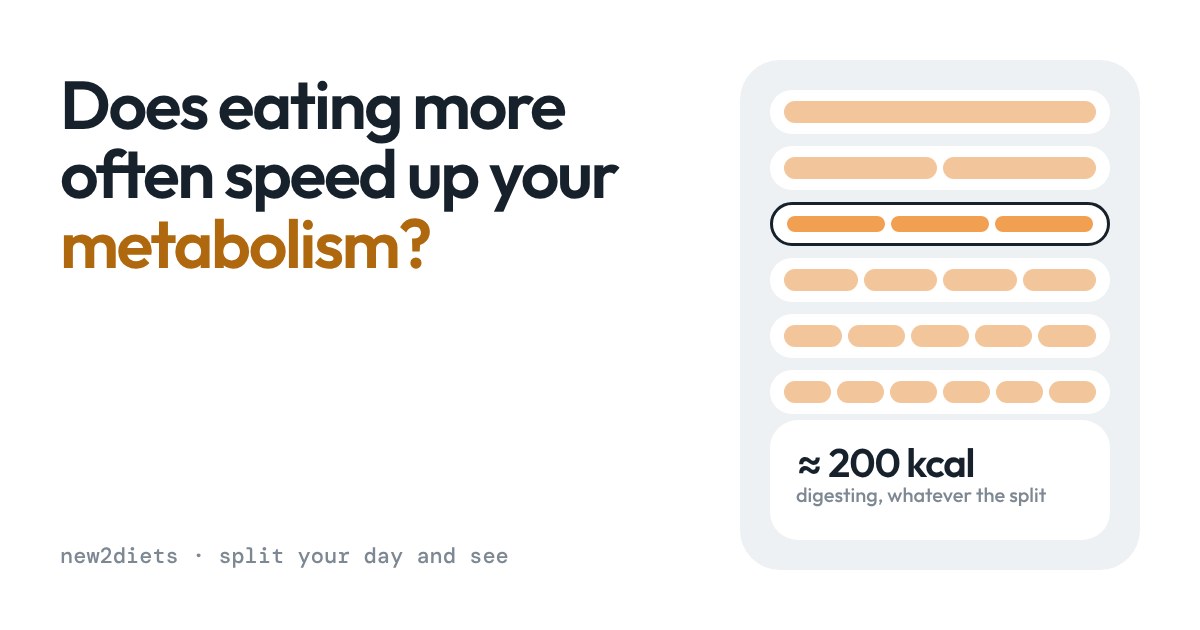
The catch is that the cost depends on how much you eat, not on how many plates it is spread across. Eat 2,000 kcal in three meals or in six, and the digestion bill is about the same, because it is a share of the same total. Reviews of the experiments find that most, though not all, small studies show no real rise in daily energy use from eating more often. Those studies are small and short, so treat the result as "probably no effect" rather than "proven none".
Try it: the same day, split differently
Enter the energy in your day's food and pick how many meals to split it into. The rows show the size of each meal and the rough digestion cost, which barely moves.
More meals do not burn more. They just cut the same day of food into more pieces.
So does it matter for weight?
A 2023 systematic review pooled 16 randomised trials in adults that compared eating three meals or fewer a day with four or more. Weight change differed by about 0.6 kg, with a very wide margin of error (it could favour either pattern), and the authors rated the evidence as very low certainty. Most of the trials had a high risk of bias. An earlier review of 31 observational studies found a mix of results (some links with lower weight, some with higher, some with none) and concluded the evidence was not sufficient to say either way.
The fair summary: at the same total energy, the number of meals does not clearly change weight. Research is limited, and anyone telling you otherwise is ahead of the evidence.
What about hunger?
Here the research really is mixed. Some small studies found that eating more often leaves people less hungry, or eating less at the next meal. Others found no difference in hunger, fullness or the hormones linked to them, and one found that a single meal a day left people hungrier than three. People differ, so what matters is the pattern you can keep.
How to choose how often you eat
- Pick what fits your day. Three meals, two meals and a snack, five small meals: all are reasonable. Choose the rhythm you can repeat on a normal Tuesday.
- Judge it by how you feel. If a gap leaves you shaky, distracted or raiding the cupboard, add something with protein or fibre. If frequent snacking leaves you eating without noticing, try fewer, bigger meals.
- Do not cut your total below the floors. Skipping meals is not a way to eat less than public minimums (about 1,200 kcal a day for women and 1,500 for men).
If you have diabetes or take medication that affects blood sugar, meal timing can matter a lot, so follow the advice from your doctor or dietitian. The same goes if you are pregnant or breastfeeding, or have or have had an eating disorder. Most of the trials above left these groups out, so their results may not apply. This guide is general information, not medical advice.
Sources
- Blazey P, et al. (2023). Systematic review and meta-analysis of randomised trials comparing three or fewer meals a day with four or more in adults. International Journal of Behavioral Nutrition and Physical Activity, 20:133. link.springer.com/article/10.1186/s12966-023-01532-z
- Canuto R, et al. (2017). Eating frequency and weight and body composition: a systematic review of observational studies. Public Health Nutrition, 20(12):2079-2095. cambridge.org
- International Society of Sports Nutrition position stand: meal frequency. Journal of the International Society of Sports Nutrition (2011), 8:4. link.springer.com/article/10.1186/1550-2783-8-4