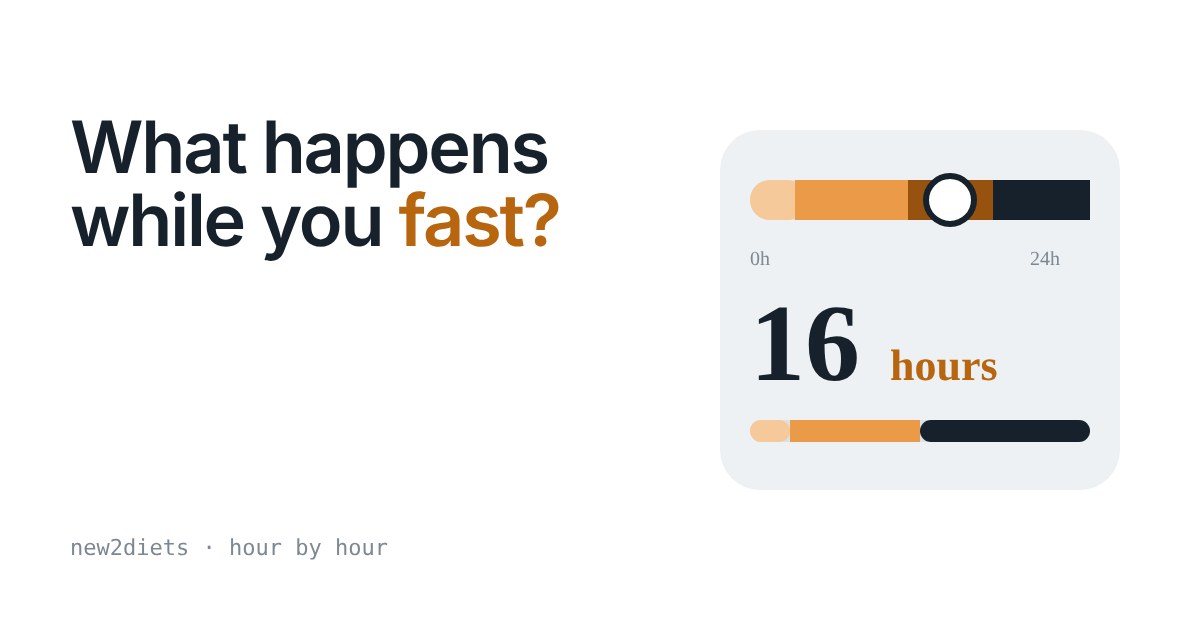
What happens in your body while you fast? Slide through the hours
Stop eating and your body doesn't flip a switch: it hands over fuel duty step by step, from your last meal to stored sugar in the liver, then to more fat and ketones.
Slide through the first 24 hours to see what's roughly happening and why exact "fat-burning hours" are too neat to trust. Not medical advice: ask a doctor first if you have a condition or take medication.
A fast is a handover, not a switch
When you stop eating, your body does not flip from "on" to "off". It hands the job of fuelling you from one source to the next, slowly and smoothly. Knowing the order of that handover makes fasting talk much less mysterious, and it shows why claims like "your body burns fat after exactly 12 hours" are too tidy to be true.
Slide through the hours below. The timings are rough: they shift with your last meal, how active you were, your age and your body. Treat them as a map, not a stopwatch.
What about fat burning and autophagy?
Your body uses fat for fuel all day, including right after meals. Fasting changes the balance, not the on/off state. You may also read that fasting switches on "autophagy", the cell's recycling process. That is well shown in animals, but how much it changes in people, and after how many hours, is not established. Anyone giving you an exact hour is guessing.
Fasting shifts the fuel mix gradually. No single hour is a magic switch.
Does it beat simply eating less?
A 2018 meta-analysis of 11 randomised trials compared intermittent calorie restriction with ordinary daily restriction and found similar weight loss, a difference of about 0.6 kg that could easily be chance. The trials were short (8 to 24 weeks), small and mostly in women, so we do not yet know about the long run. The honest summary: fasting is one way to organise eating, and it works for some people because it is simple, not because of a special hour.
Who should not fast
This guide is information, not medical advice. Skip fasting and talk to a doctor first if you have a condition such as diabetes, are pregnant or breastfeeding, have or have had an eating disorder, or take medication, especially for diabetes or blood pressure. Fasting is also not advised for children and teenagers. If you feel faint, unwell or preoccupied with food, stop eating normally again and ask a professional.
Fasting does not change what your body needs: you still need enough food, protein and fibre across your eating window, and a very low intake is not safe just because it is packaged as a fast.
What to take away
- You already fast every night; 12 hours between dinner and breakfast is normal.
- The body shifts from the last meal, to liver glycogen, to more fat and ketones. The edges blur.
- Claims of exact hours for "fat burning" or autophagy go beyond the evidence.
- Fasting is a scheduling choice, not a shortcut. Pick the pattern you can keep up comfortably.
Sources
- Physiology, Fasting, StatPearls (NCBI Bookshelf): glycogen as the main glucose source in the first ~24 hours, then gluconeogenesis and ketones.
- Bo et al. 2018, Journal of Translational Medicine: intermittent versus continuous energy restriction, 11 randomised trials.