How long does a meal-prep session take? Pick your dishes and see the best order
Cooking for the week takes far less time if you start the long, hands-off jobs first. Pick the dishes you want to make and see the order to start them in, how long the session takes compared with cooking one after another, and the hands-on time either way.
Each dish also shows its fridge-or-freezer deadline, because the food-safety clock starts when cooking ends. Based on Food Standards Agency guidance.
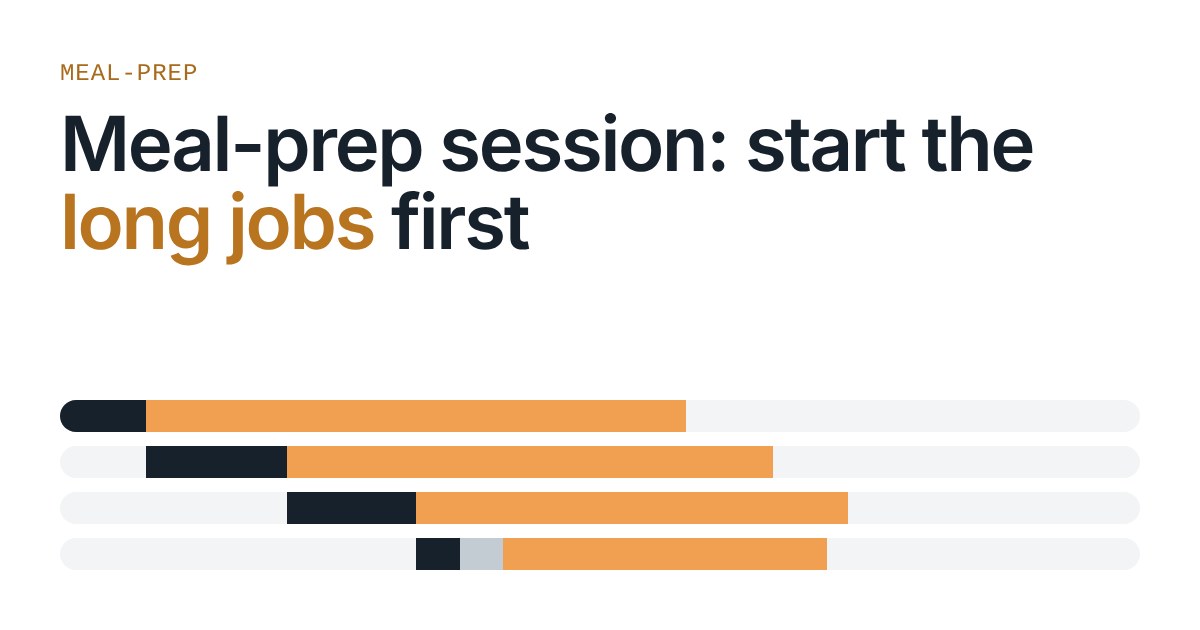
You have a free Sunday afternoon and a plan to cook for the week. Two hours later you are still chopping, the oven has been cold for 40 minutes and everything finishes at once. The trick is not to cook faster. It is to start the long, hands-off jobs first, so they cook while your hands are busy with the short ones.
Hands-on time and hands-off time
Every dish has two kinds of minutes. Hands-on minutes are chopping, seasoning and stirring, when you cannot do anything else. Hands-off minutes are roasting, simmering and boiling, when the oven or the pot does the work. A tray of roast vegetables might be 15 minutes of chopping and 35 minutes in the oven. If you cook dishes one after another, you wait through all 35. If you overlap them, that wait disappears.
The rule is simple: prep the dish with the longest cooking time first, get it onto the heat, then move to the next. You are limited by what you own: one oven (two trays fit in most) and three hob rings is a fair guess for a home kitchen.
Plan your prep session
Pick the dishes you want. The plan shows the order to start them in, how long the session takes compared with cooking one after another, and when each dish needs to be in the fridge or freezer.
Start the dish with the longest cooking time first. Everything else fits in around it.
The safety clock starts when cooking ends
Overlapping dishes means they finish at different times, and each one has its own clock. The UK Food Standards Agency (FSA) says cooked food should be cooled and refrigerated within one to two hours. It says not to put steaming hot food straight into the fridge, and that dividing food into smaller portions helps it cool faster. The plan above shows that deadline for each dish.
Plan the end of the session too: shallow tubs, a clear spot on the counter and space in the fridge. The FSA says to keep the fridge between 0 and 5°C, and to eat leftovers within 48 hours or freeze them. Other countries' guidance allows a little longer, so if you are unsure, use the shorter window. Freeze portions you will not eat in time, at around -18°C. Cooked food can be reheated once after freezing.
A few habits that keep a session smooth
- Switch the oven on first. Preheating is hands-off time you would otherwise lose.
- Clear a surface before you start. Tubs need space to cool in a single layer.
- Raw before cooked. Handle raw meat last among the chopping jobs, wash the board, and never put cooked food on a surface raw meat touched.
- Do not overload a tray. Crowded vegetables steam instead of roast, which adds time.
- Reheat until steaming hot throughout, once.
Who should be more careful
This guide is general information, not medical advice. If you are pregnant, older, have a weakened immune system, or cook for someone who does, food-safety advice is stricter for you, so ask your doctor, midwife or dietitian. The same applies if you have a condition, take medication or have or had an eating disorder and are changing how you eat.
Sources
- Food Standards Agency: How to chill, freeze and defrost food safely (fridge 0 to 5°C, cool then refrigerate within one to two hours, leftovers within 48 hours, freezer -18°C).
Preparation and cooking times are typical home-kitchen estimates, not published standards.